







If you ask almost any adult the last time they had an informal health assessment, you’ll get a stunned, silent response. People are not uncaring; it’s just that they aren’t. The waiting room, the thought of being recognised and the awkward chat with the front desk.
However, STD infections are one of the most prevalent in the world. Many people get infected with more than a million each day and without any symptoms at all, according to estimates from the World Health Organization.
The good news is that testing has become far more private. With an STD test at home, a qualified professional collects your sample discreetly, an accredited lab analyses it and the results come straight to you. This guide covers what to test for, when to test, how the process works and what to do with your results.
Why Feeling Fine Isn’t Proof of Being Clear
The single most common misunderstanding of this aspect of health is that someone would know that something was amiss. Often you wouldn’t.
- Chlamydia causes no symptoms in a large share of women and many men.
- Gonorrhoea is frequently silent, even while the infection is active.
- HIV may cause a short flu-like illness, then nothing noticeable for years.
- Hepatitis B and C can damage the liver quietly for a long time before signs appear.
- HPV usually clears on its own, but high-risk types can cause cervical changes without warning.
If left untreated, some of these infections may cause pelvic inflammatory disease, infertility, pregnancy problems or cause long-term damage to the organs. Most bacterial STIs can be treated with a short course of antibiotics and viral infections are very treatable if caught early. It’s testing that makes a potential long-term problem an easy appointment.
What a Screening Covers and When to Test
The timing of the test is as important as the test itself. There is a window period between exposure and when a test will be able to detect an infection. Testing too soon can lead to a false sense of security.
| Infection | Sample | Typical window period |
| Chlamydia | Urine or swab (PCR) | About 1 to 2 weeks |
| Gonorrhoea | Urine or swab (PCR) | About 1 to 2 weeks |
| Trichomoniasis | Urine or swab (PCR) | About 1 week |
| Mycoplasma genitalium | Urine or swab (PCR) | About 2 weeks |
| HIV (4th-generation antigen/antibody) | Blood | About 2 to 6 weeks |
| Syphilis | Blood | About 3 to 6 weeks, up to 3 months |
| Hepatitis B | Blood | About 3 to 6 weeks |
| Hepatitis C | Blood | About 8 to 12 weeks |
| Herpes (HSV antibodies) | Blood | About 3 to 16 weeks |
These are only general ranges and do not guarantee results. Repeat testing three months after the specific exposure will yield a definitive answer if the initial testing is early after the exposure. Blood tests are also less reliable in the absence of symptoms and are recommended only on a case-by-case basis.
Most providers will provide panels, which will be either single panels or multiple pathogen PCR testing, which will be a PCR test of more than one infection on a single sample. A wide panel is good for general screening; a more limited test is appropriate when you know what you’re looking for.
How Private Sample Collection Works
The process is structured in such a way that no one but you and your care team will know what tests you were done for.
- Book confidentially. Choose a panel online or by phone. Reputable services don’t require you to explain your reasons.
- A licensed professional visits. A nurse or phlebotomist arrives in plain clothing or a standard uniform, with no test names on bags or kits.
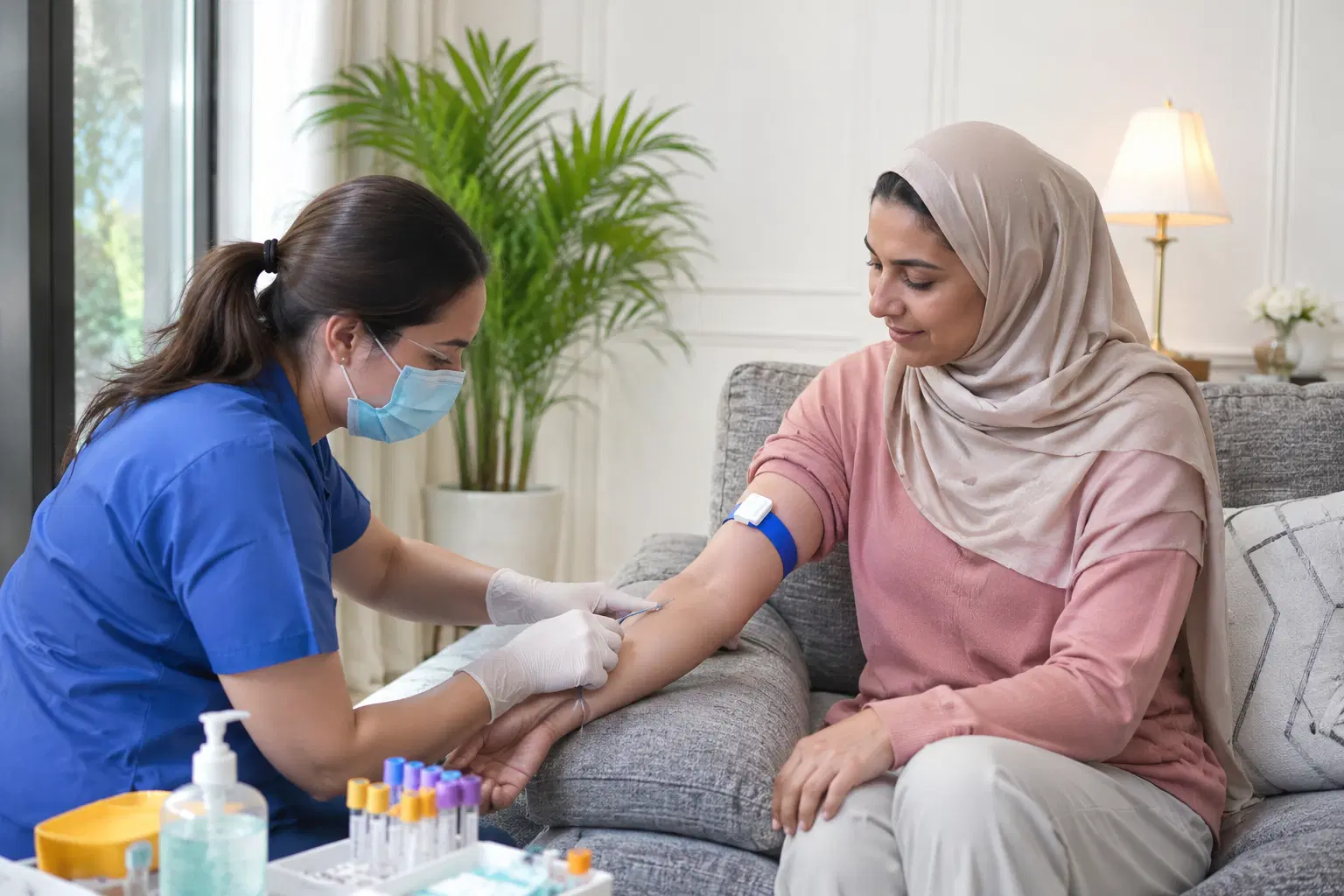
- Samples are collected in minutes. Depending on the panel, this may be a small blood draw, a urine sample, or a self-collected swab done in private.
- Samples are coded, not named. They are labelled and sealed on the spot, then transported under controlled conditions to the lab.
- Results arrive securely. Reports are sent through a protected link, app, or encrypted email, usually within 24 to 72 hours for PCR panels.
This is the biggest barrier to people getting tested – for anyone concerned about being seen at a clinic.
Who Should Get Tested and How Often
STD screening is not just for those who believe that they are at risk of exposure. It’s a regular checkup screening similar to a cholesterol check. Consider testing:
- Before a new relationship, ideally with your partner, so you both start with a clear picture.
- After any possible exposure or a change of partner, timed to the window periods above.
- Once a year unless you’re in a long-term exclusive relationship.
- Every three to six months if your doctor considers you at higher risk.
- Before planning a pregnancy or during antenatal care, since syphilis, HIV and hepatitis B can pass to a baby.
- As part of a pre-marital or pre-employment medical, where screening is often required anyway.
- Whenever you notice symptoms, such as burning when passing urine, unusual changes, skin sores, rashes, or pelvic pain. Don’t wait for a scheduled check.
How Accurate Is It and How Do You Choose a Provider?
If collected and transported correctly, the results are as valid as a clinic visit, as the analysis will be carried out in the same lab. Modern PCR (nucleic acid amplification) tests are very specific and sensitive and detect the genetic material of bacteria and viruses directly.
It’s not a quality risk if it’s the location. It’s the provider. When looking to book, verify the following:
- A licensed laboratory, approved by the local health authority (in Dubai, the Dubai Health Authority).
- International accreditation, such as ISO 15189 or CAP, showing the lab’s quality is independently audited.
- PCR-based testing for bacterial infections rather than older, less sensitive methods.
- Qualified collectors, not couriers, who follow proper hygiene and labelling.
- A clear privacy policy covering how your data and results are stored and shared.
- Doctor support to explain results and arrange treatment if anything comes back positive.
In Dubai, providers such as Genex offer a range of PCR-based panels with discreet home collection, which is the kind of setup worth looking for wherever you live.
What to Do When Your Results Arrive
If the results for both infections are negative: see if you had been tested within the timeframe of the period of time the lab looks for the infection. If you were recently exposed, make an appointment for a repeat test at three months. If not, continue with your normal screening regimen.
If something is positive: take a breath. Most STIs are common, treatable and nothing to be ashamed of.
- See a doctor promptly. Chlamydia, gonorrhoea, trichomoniasis and syphilis are usually cured with antibiotics. HIV and hepatitis B are well controlled with modern medication.
- Avoid intimate contact until treatment is complete and your doctor confirms it’s safe.
- Tell recent partners so they can test and get treated too. It’s an uncomfortable conversation, but it prevents reinfection and protects their health.
- Retest if advised. Some infections need a “test of cure” a few weeks after treatment.
Either way, it’s information, not judgement. Self-knowledge is the first step to self-protection and the protection of those around you.
The Bottom Line
The test for STDs is routine preventive medicine and doesn’t require a waiting room. Be aware of the window periods, select a lab that performs PCR testing and practice screening as a routine rather than a response to anxiety.
A little private sample collection offers you and loved ones peace of mind, for a few minutes.
Explore Also: Muhaisnah Medical Center: Location, Services, Medical Fitness, Timings and Complete Guide
Frequently Asked Questions
Is an STD test at home as reliable as one done at a clinic?
Yes. If gathered by a trained individual and analysed in an accredited laboratory, the results are just as accurate. All lab equipment and quality checks are identical.
Will anyone else know what I was tested for?
A good provider maintains privacy in regard to bookings, packages and reports. Results are available only to you unless you share the results with your doctor.
Do I need to stop taking antibiotics before testing?
Let the collector know if you have recently taken antibiotics. They can also inhibit bacteria, leading to a false negative result, so your doctor may recommend waiting a few weeks.
Should I test during my period?
Blood tests are not affected. In the case of urine or swab tests, it’s generally best to wait until bleeding has ceased.
Can I test with my partner?
Yes and it is a good idea. Testing together eliminates the guesswork and allows a conversation to take place more easily.
How soon will I get results?
Most PCR and blood panels are reported within 24 – 72 hours. Charges on larger panels or confirmatory tests may be a bit longer.