
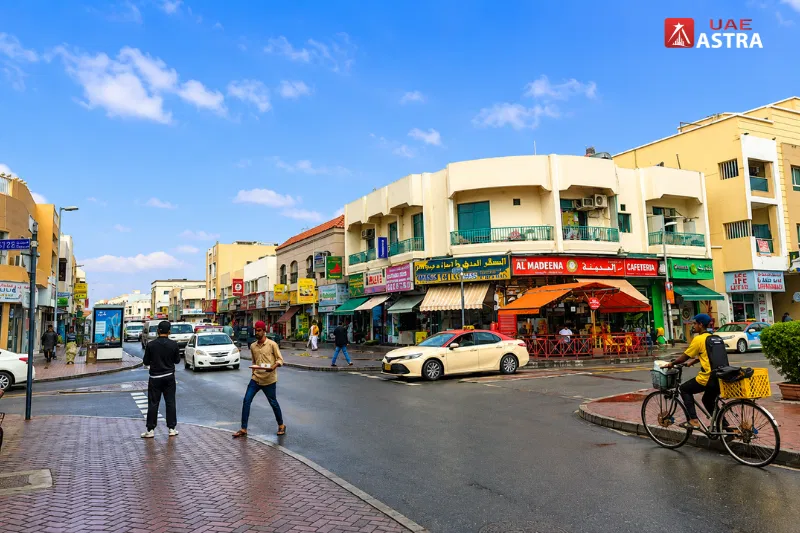
Hor Al Anz Dubai is an established residential and commercial community in Deira, known for its central location, busy local markets, apartment housing and strong public-transport connections. The area consists of Hor Al Anz and Hor Al Anz East, which had a combined population of 116,259 in 2024, according to Dubai Statistics Center data.
The community is near Al Ittihad Road (E11), Abu Baker Al Siddique Road, and the Dubai–Sharjah side of Al Rasheed Road, which offers easy access to Deira, northern Dubai, and the Dubai–Sharjah side of the city. The Green Line stations surrounding it are also a convenient place for public transit users.
Hor Al Anz Dubai at a Glance
Hor Al Anz is part of Deira, and the eastern part of the community, which is close to Al Ittihad Road and the Dubai–Sharjah border, is known as Hor Al Anz East. The two areas have a blend of housing blocks and retail, food, office, and services, and a well-established and urban feel.
| Feature | Details |
|---|---|
| Location | Deira, Dubai |
| Sub-areas | Hor Al Anz and Hor Al Anz East |
| Population (2024) | 116,259 combined |
| Main roads | Abu Baker Al Siddique Road, Al Ittihad Road, Al Rasheed Road and Baghdad Street |
| Metro access | Abu Baker Al Siddique, Abu Hail and Al Qiyadah are nearby Green Line stations |
| Property types | Apartments, villas, land and commercial properties |
| Area character | Established residential and commercial community |
| Nearby side | Close to northern Dubai and the Dubai–Sharjah corridor |
According to official statistics for 2024, 92,239 people are living in Hor Al Anz and 24,020 in Hor Al Anz East. These are independent Dubai Statistics Center community codes, and the sum of 116,259 should be interpreted as the total population of the two areas, not as the official population of Hor Al Anz itself.
Where Is Hor Al Anz Located?
Hor Al Anz is situated in the northern area of Dubai, Deira, and extends to Al Ittihad Road (E11), which is a vital road linking Dubai and Sharjah. Abu Baker Al Siddique Road also links to the central part of the community, and Al Rasheed Road and Baghdad Street are both connected to surrounding residential and commercial areas.
The neighbourhood is split into two: Hor Al Anz and Hor Al Anz East. The main area of Hor Al Anz is towards Abu Baker Al Siddique Road and Abu Hail; Hor Al Anz East is nearer to E11 and Al Qiyadah. The difference can impact the proximity of a home to the metro, major roads, retail and other everyday amenities.
One of the key practical benefits of its location is its proximity to the city. Deira and northern Dubai can be accessed by residents, who need not live far out of reach of established commercial centres, and residents heading towards Sharjah have direct access to the E11 road.
Hor Al Anz vs Hor Al Anz East
The names are sometimes used interchangeably online, but they are not the same planning area. The main community is Hor Al Anz, with Hor Al Anz East extending towards E11 and being separately coded.
The difference for a renter is not just an administrative one; it’s practical. For those who are looking for accessibility to Al Qiyadah Metro and E11, the eastern side can be advantageous. The central area may be more amenable to residents wishing to have established local retail, services, and access towards Abu Baker Al Siddique and Abu Hail.
History and the Story Behind the Name

As opposed to many modern area articles, Hor Al Anz has a more intimate relationship with Dubai’s ‘older’ residential development. According to the National, the neighbourhood was built in the early 1970s as a government housing project for Emirati families. The other story tied the name to Al Anz, a horse belonging to Dubai’s former ruler, Sheikh Saeed bin Maktoum.
The origin of the name is also mentioned in the historical-neighbourhood material from Bayut. Those sources say that the horse was named Al Anz and the locality was named after it. The history is important because it provides an explanation for the character of the neighbourhood, which is quite distinct from the newer master-planned districts, in that its urban form has evolved around the pre-existing streets and low-rise housing.
The community underwent significant changes over time. As Dubai grew and jobs, trade and housing boomed, the once mostly local residential area turned into a much more diverse urban district. Low-rise old buildings are now coexisting with newer apartment blocks, shops and restaurants, and service businesses.
Population and Growth
The one thing that lends a great deal to the improvement of this article over many of its competitors was its reliance on the existing and official community-level population numbers and not using the old number of about 40,000.
According to the 2024 population estimates released by Dubai Statistics Center, community 127, Hor Al Anz, has a population of 92,239 residents, while community 133, Hor Al Anz East, has 24,020 residents. The two planning communities together are home to 116,259 residents. From the same official table, the areas are 1.8 Sq. km. and 1.4 Sq.km. respectively.
In 2020, Dubai Statistics Center had a population bulletin that showed 83,529 residents in Hor Al Anz and 21,430 in Hor Al Anz East, which adds up to 104,959. Over the four years from 2020 to 2024, the population of the two official community codes grew by about 10.8%, or 11,300 residents.
| Official community | 2020 population | 2024 estimate | Change |
|---|---|---|---|
| Hor Al Anz | 83,529 | 92,239 | +8,710 |
| Hor Al Anz East | 21,430 | 24,020 | +2,590 |
| Combined | 104,959 | 116,259 | +11,300 |
The figures above are derived directly from the two entries by Dubai Statistics Center in the community. The totals are therefore analytical, and do not represent a single-community value that has been published separately.
The 2024 data also shows the density of the neighbourhood. Main Community has an official population density of around 52690 and Hor Al Anz East has an official population density of around 17440 per sq km. These are calculations made using data for population and area provided by the Dubai Statistics Center.
Rental Prices and Property Market

This is one of the most popular things to look for in this neighbourhood is the property market. It is not a place where all homes cost nothing; it is a place where there is a wide selection of older and newer apartments, located in the heart of Deira, and public transport and daily services are nearby.
Property Finder’s community-level rental snapshot listed annual rents of about AED 33,000 for studios, AED 42,000 for one-bedroom apartments, AED 69,000 for two-bedroom apartments and AED 101,000 for three-bedroom villas. These figures were based on the preceding 12 months and should be treated as market indicators rather than guaranteed prices for every building.
This is where the current offerings for 2026 illustrate why one average rent is not necessarily accurate. Studio listings over the last few years have ranged from approximately AED 28 000 to AED 50 000 annually based on condition, location, size, and building. Other studios are listed higher, with listings in Bayut of some studios in several Hor Al Anz buildings in the neighborhood of AED 32,000 to 33,000.
Property Finder also has current rental listings in the community; available studios and apartments are listed. For example, proximity to metro stations, apartment size, building age, and furnishing can make for significant variations in asking rent, as demonstrated by individual listings.
The bottom line is that the total annual cost should be compared, which includes more than just the headline rent. The lower-priced apartment may be further from the metro, which will result in extra travel expenses and time. A slightly more expensive model closer to a station or large bus lane could be a better daily value option.
The sales market is a different one. Currently, Property Finder has fewer sales in the Deira community than other newer communities in Dubai, and it offers properties such as whole buildings, plots, and villas rather than just apartments. According to the current data from its community, the average price for Hor Al Anz is AED 2.34 million and for Hor Al Anz East is AED 4.15 million (listing data). These should be regarded as market indications and not valuations for any specific property.
The ownership of the specific property should also be verified by the investor. The available properties in the area include those that are not freehold, and the rules for ownership may vary from plot to plot and property to property. Current investment listings, for instance, clearly spell out that one of the properties in an investment is non-freehold: Hor Al Anz residential building. Purchasers should therefore check the title and the permitted ownership, and ensure that there are DLDs in place before investing.
Metro, Bus and Road Connectivity

One of the greatest arguments for considering the neighbourhood is public transport. The Green Line offers convenient stations throughout the neighborhood: Abu Baker Al Siddique, Abu Hail and Al Qiyadah are located in different parts of the community and its outskirts. The Dubai Metro published RTA information links these stations to the Dubai bus network, which runs to Hor Al Anz and other districts.
Abu Baker Al Siddique is very useful for the main Hor Al Anz side. Abu Hail is located on the central/northern end and offers bus services too. Al Qiyadah is particularly significant for Hor Al Anz East as it lies on Al Ittihad Road.
RTA bus information shows that buses are available from the East too. The C09 route between Satwa Bus Station and the eastern community passes through the stops of Hor Al Anz East, Qiyadah Metro, Hor Al Anz East Dar Al Aman and Hor Al Anz East Terminus.
Residents should always verify their RTA bus route and time before depending on an RTA/S’hail published route number in an article, as it may have changed.
E11 is the main road on the island for drivers, and the roads into and out of the capital of the island lead to Deira, Al Mamzar, Al Qusais and other parts of the north of Dubai. The result is congestion and parking hassles. According to both Bayut and Property Finder, among the practical challenges residents might encounter is finding parking, especially in dense areas.
Schools and Education
Families should check the precise location of the school instead of assuming that all schools in the “near Hor Al Anz” section are in the neighbourhood.
Little Flower English School is the one confirmed school in Hor Al Anz. A KHDA inspection document rates the school as being in Hor Al Anz, opened in 1984, and includes boys and girls from KG1 to Grade 6. The document for the inspection (2023-2024) shows that there were 927 students on roll.
Depending on curriculum and travel requirements, other schools are available in neighbouring communities and may be considered. Current area data from Property Finder lists the following schools in the area: Pearl Wisdom School, Queen International School, Sabari Indian School, Dubai Scholars Private School and Al Ittihad Private School.
This makes this location viable for families, but school choice needs to be based on the child’s year group, curriculum, fees, transport and daily commute and not based on distance.
Healthcare and Essential Services
Healthcare and everyday services are embedded in the broader Deira area, which provides benefits to the neighbourhood. Dubai Hospital is one of the main points of reference close by, and medical centres, pharmacies, and clinics are distributed in the surrounding community. Healthcare and other key facilities are clearly flagged as amenities in the Hor Al Anz wider area in Bayut’s area information.
Local residents can typically find pharmacies, grocery stores, salons, mobile stores, restaurants, and service providers without having to go very far. Convenience is one of the hallmarks of older neighbourhoods in Deira, as opposed to being clustered in one master-planned retail centre.
Shopping, Supermarkets and Restaurants

Shopping is one of the least difficult things to do here. Residential streets are serviced by local supermarkets and grocery stores, and larger centres of shopping are just a short drive away.
Local grocery stores listed by Bayut include Talal Supermarket, Al Manama Supermarket and Hadeer Supermarket. Retail choices are available in the vicinity such as Reef Mall, City Centre Deira, Al Ghurair Centre, Century Mall and Abu Hail Centre.
Reef Mall is significant for everyday shopping, and City Centre Deira offers more variety of retail, food, and entertainment options. Al Ghurair Centre is also a shopping destination in Deira, and Century Mall has a Carrefour outlet to buy bigger groceries.
Food is no different from the kitchen, either. Although there are many restaurants in these destinations, there are many casual restaurants, cafeterias, bakeries and tea shops available for local residents. The area is also home to a large number of people from diverse backgrounds such as Indian, Pakistani, Arabic, South Asian and Filipino, and these cuisines are easily accessible. According to the area research done by Bayut, there are various Indian, Arabic, and South Indian restaurants around and in the community.
Parks, Recreation and Daily Life
Hor Al Anz Park is a well-known local recreational area in the neighbourhood. The community is also conveniently located near parks and other nearby recreation areas in Deira and the north of Dubai.
If you are looking for a larger outdoor excursion, then Al Mamzar Beach Park is one of the best options in the area, especially for those living in Hor Al Anz East. Based on the area information provided by Bayut, the park is located approximately a short drive from the eastern part of the community, and is noted for its beaches, green spaces and recreational facilities.
Convenience means more to the everyday person than sophisticated amenities at a resort. Grocery, meals, basic services and commuting, as well as many errands, can be done locally. The flipside is that where it’s convenient, there’s also noise, traffic and parking pressure.
Hor Al Anz Library and Community Facilities

Hor Al Anz Library is a very helpful but sometimes overlooked library. It is included in Dubai’s official library directory by Dubai Culture, and its official contact details are given here.
This is important because this is not just a neighbourhood for renting residential homes. It has infrastructure for a community that can support longer-term everyday life, such as public services, retail, transport, and cultural facilities.
Postal Code and P.O. Box
One frequently asked question is, “Does the neighbourhood have a distinctive postal code? The saner response is that you shouldn’t create one.
The official addressing instructions for Emirates Post require the sender to include the recipient’s name, P.O. Box number in the address, followed by the physical address and then the emirate and telephone number. Emirates Post further states that P.O. Box numbers are assigned to the subscriber, and not to a neighbourhood as such.
If the address of the person to whom something is being sent has a P.O. Box, include the P.O. Box address with the building and street address and flat or office details with the recipient when sending to Hor Al Anz. Where a website requests a “postal code” for a form on their website, the field in which it is required depends on the service in question – the random 5-digit number is not an official Hor Al Anz postcode.
Today, Emirates Post has introduced personal P.O. Box services and also has home mailbox services, which further underscores the difference between a subscriber’s address and a neighbourhood postcode.
Is Hor Al Anz Dubai a Good Place to Live?
It all depends on what you value. The neighborhood is very functional for a tenant looking for centrality, access to the metro, local shopping and a fairly wide choice of rents. It might not be as appealing for someone who prefers quiet streets, landscaped public spaces, large modern apartments and plenty of parking.
Main advantages and disadvantages
- Strong transport: Green Line stations and bus connections make commuting easier, particularly for residents who choose homes close to a station.
- Everyday convenience: Groceries, restaurants, pharmacies, salons and other services are widely distributed through the community.
- Established location: The area sits within old Deira rather than a distant suburban development, keeping many central destinations within practical reach.
- Rental choice: Studios and apartments are available across a wide range of buildings and price points.
- Multicultural environment: The neighbourhood has a diverse resident and business population.
- Parking pressure: Older and denser streets can be difficult for residents who depend on private cars.
- Noise and density: Busy roads, shops and high occupancy can make some pockets less peaceful.
- Building quality varies: Older buildings can differ significantly from newer properties in maintenance, layout and facilities.
- Family suitability varies by pocket: Families can live in the area, but the experience depends strongly on the exact building, street and proximity to schools and parks.
So, basically the most effective way is to pick the micro-location first and then the apartment second. Properties that appear cheap online may not be worth the money if they have challenging parking, require extensive maintenance, or are a far walk to public transportation.

Who Should Choose the Area?
The best fit is for residents who wish to settle in a Dubai that has already established itself and wouldn’t want to pay the higher rates of many newer masterplanned communities. The transport system is especially useful for working people who use the metro or buses to commute to and from work.
It can also be used for couples or families that choose a quieter building, have parking, and do research on the nearby schools before signing a tenancy. The residents who come in from the east, frequently heading toward Sharjah or north Dubai, might find the area appealing, due to its proximity to E11.
That means investing requires more diligence for investors. The location, density, services, and demand for rentals are all contributing factors, but the investor must also consider the type of ownership, condition of the building, the type of tenants, the costs of maintaining the building, the actual rental income, and other transactions that are similar to the one under consideration and not a generic “high ROI” promise. A review of the current sales listings illustrates that properties differ in type and ownership within the neighbourhood.
How to Choose the Right Apartment
Spending the least amount of money per year does not necessarily mean that the apartment will be the best. When looking at a building, look at it at different times of the day before signing a tenancy. Check for street noise and parking at night, and distance to the nearest metro or bus stop.
Inquire with the agent or landlord about central air, maintenance, parking, chiller/utility requirements, deposit requirements and agency fees. If the apartment is to be shared or offered for rent to several persons, confirm that the arrangement is in line with the applicable tenancy and building regulations.
If you are a family, look for the real route to school and the presence of outdoor space in the vicinity. If someone is commuting, measure the actual walking time to the station (not a list stating “near metro”).
Final Verdict
This is not a community that is going to try and outcompete Dubai’s luxury residential areas, and that’s what makes it relevant. It is a place with many strengths: it is in use in the day-to-day, it is well established, it has an array of non-gambling public-transport access and a wide rental market, and it is a multicultural street life.
The latest Dubai Statistics Center data also indicates that the population of both official community codes that cover the area was 116,259 in 2024, compared to 104,959 in 2020. This development and its existing transport and service network are one of the reasons people continue to move to the area.
Hor Al Anz Dubai may be an excellent choice for those looking to move in rather than enjoy resort amenities, commuters, or anyone who prioritizes convenience over luxury. Judging the street and building and not the name of the neighbourhood is the key. That way, you get a far more realistic idea of rent, parking, transportation, schools, and everyday life expenses.
You may also like: Al Muraqqabat Dubai Beyond the Map: History, Growth and Daily Life
Al Shaiba Tower A: Apartments, Location, Amenities & Living in Dubai Guide
Bayswater Tower Business Bay: A Closer Look at One of Dubai’s Established Office Towers
FAQs
What is Hor Al Anz known for?
It’s recognized for its history of activity in the Deira area, high population density, low to mid-range rental prices, multicultural society, local stores and extensive public transportation.
Is the area good for families?
While possible, it depends on the budget. Families should investigate the specific building, parking, school transportation, noise, and access to parks before renting. The neighbourhood is also very much focused on the working adult—there are nearby schools and community facilities that enable families to live here.
Which metro stations serve the community?
The most relevant Green Line stations to the area are: Abu Baker Al Siddique, Abu Hail and Al Qiyadah. The best station is determined by where you reside in the community – main or eastern part.
Does Hor Al Anz have a postal code?
Don’t use a “supposed” neighbourhood postal code. The official addressing for Emirates Post is the recipient’s P.O. Box address, which is followed by the physical address, emirate, and telephone number.
Are current population figures available?
Yes. According to the community estimates of Dubai Statistics Center for 2024, the population of Hor Al Anz and Hor Al Anz East is 92,239 and 24,020, respectively. These are the official codes of the communities and add up to 116,259 residents in the two communities.