

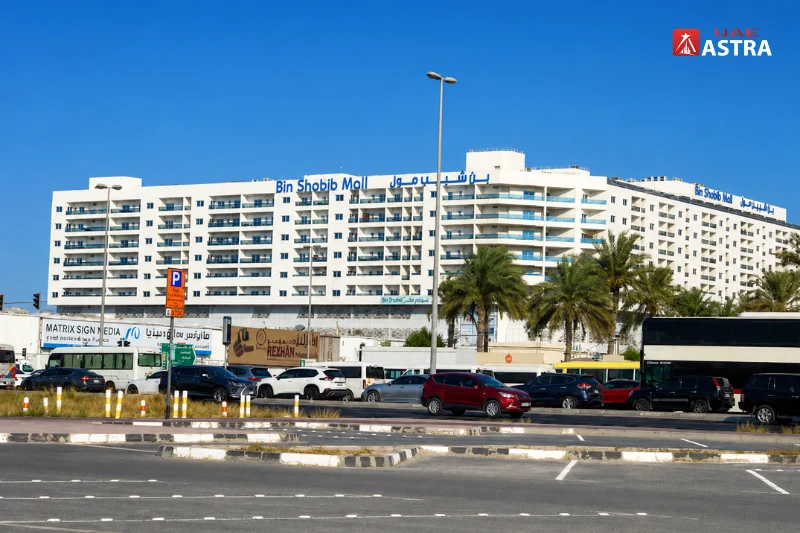
While Dubai has some of the world’s most popular shopping zones, neighbourhood shopping centres provide a more convenient, accessible and functional experience and are a popular choice for the majority of residents. Bin Shabib Mall, which is located in eastern Dubai, has emerged as a well-known shopping venue in the Al Qusais Industrial Area 1 for residents, office dwellers and commuters in the surrounding area.
This retail landscape is more related to everyday urban life than large destination malls that are typically created primarily for the purpose of tourism and entertainment. It is a useful commercial centre for the surrounding areas for shopping for groceries, casual dining, retail shopping, and common day-to-day errands.
Community-Focused Shopping Environment
The development is located in one of Dubai’s thriving mixed-use districts comprising residential, commercial, educational and industrial properties all in close proximity. Such a mix ensures steady foot traffic all day long and fosters a steady retail ambiance built around ease and simplicity.
The proximity of the Dubai–Sharjah movement corridor also enhances the visibility and daily visitors from the surrounding areas to the mall.
Connection With Dubai’s Mixed-Use Commercial Growth
The development itself is linked to the Abdulwahed Bin Shabib Group with commercial involvement in various sectors in the UAE. The project has also been made public as one of the mixed-use retail and residential developments located in one of the important urban-commercial zones in the east of Dubai.
This has helped to reinforce its image as a community shopping centre as opposed to just a tourism shopping centre.
Location and Accessibility in Al Qusais
The mall’s prime location within Al Qusais Industrial Area 1 is one of its greatest strengths, particularly in the sense that it now has an active function in one of Dubai’s most prolific residential-commercial pockets. The region is renowned for its industrial activities, business opportunities, and residential neighbourhoods, along with its transport links.
This urban design allows people of all ages to access the mall at any point during the week. People from surrounding areas often come for shopping and eating, and office workers and commuters come during working hours.
The surrounding road infrastructure extends the accessibility of the visitors from other parts of Dubai and neighbouring Sharjah.
Road Connectivity and Urban Movement
The location is close to key roads and transport infrastructure that link eastern Dubai with other districts, which enhances the overall development potential. This ensures good commercial exposure and allows the mall to be more easily accessible to residents and commuters.
The Dubai-Sharjah movement corridor is still one of the busiest corridors for urban movement in the UAE. This region of Dubai is traversed by thousands of people on a daily basis for their work, study and commerce. Proximity can also provide retailers with additional sales opportunities if they line up retail offerings close to these transportation routes, with the added benefit of staying top of mind with consumers and with regular foot traffic.
The mall used to function as a shopping mall and had visitors spend days there, but it is now designed to accommodate convenience shopping. Many guests combine shopping, grocery shopping, eating and/or service use in their everyday activities.
Public Transport and Nearby Accessibility
The mall’s popularity is also aided by the facility of public transport. Dubai’s public transport system includes improved bus routes, taxi services, and nearby metro connectivity to facilitate the movement of individuals who rely on public transportation.
Retail centers with transportation links tend to have a more consistent number of daily users as they are readily available for access without relying solely on private automobiles.
The same level of accessibility also reflects Dubai’s broader urban development philosophy, as community retail infrastructure becomes more insular with residential developments and public mobility.
Shopping Experience and Retail Environment

The shopping experience within the mall has a greater emphasis on its utilitarian aspects and easier accessibility than on luxury retail branding. This makes the destination particularly useful for people living nearby as a convenient spot for everyday shopping rather than for tourism purposes.
Community shopping centres are unique in many ways. People tend to come to Fairview with a definite intention of buying items instead of spending the day checking out the entertainment facilities.
Retail in the Mall caters to various categories of shopping and provides convenience, electronics, groceries and services.

Retail Categories Available
The local retail landscape, overall, does have some support for several retail types that cater to regular, everyday shopping needs:
- Fashion outlets and clothing outlets
- Vending mobile accessory and electronics stores
- Grocery shopping and/or shopping at a supermarket.
- Convenience retail businesses
- Lifestyle and household products
This “mixed-use” retail strategy can draw people from nearby areas who want to make several shopping stops in their local area, all in one place.
It is not an environment of luxury brands from overseas, but it is one where shopping is affordable, accessible and one which offers a retail experience which is convenient.

Convenience-Based Consumer Behaviour
Dubai’s modern shopping has evolved over time to more convenient retail environments. More people these days are choosing the convenience of shopping in nearby shopping centers where they can do their grocery shopping, dine and do all their home needs without having to travel a long distance.
This trend has made community shopping centres more relevant in the residential-commercial areas of Dubai’s east.
The characteristics of the mall environment are very similar to this pattern as it allows for rapid visits, daily shopping and easy flows among the retail outlets.
Dining Options and Casual Food Experience

Food services are a key component of the overall visitor experience. Dining establishments, coffee shops and fast food places serve the local community and surrounding employees all day.
The activities in Al Qusais can be ongoing, as the district is very business-intensive and has a diverse population.
Typically, the lunchtime commute, during working hours, is the main contributor of traffic in the office building and service environment, whereas evenings see families and nearby residents visiting to find an informal, casual dining venue.
Restaurants and Cafes
The overall feel of the dining area is more work for them than a luxury fine-dining experience. There is a range of cheap-to-moderate price restaurant options, a few cafes, and fast food options available for visitors to choose from based on their budget and preferences.
Meanwhile, the burgeoning cafe culture movement in Dubai has also shaped community shopping areas, with many retail locations featuring coffee corners and casual dining areas.
The restaurants help to enhance the ambiance of the mall and also help to keep visitors’ length of stay in the evenings and weekends.
Family-Oriented Dining Experience
The element of family-friendly dining is still significant in neighbourhood shopping centers, as a great deal of neighbourhood residents visit for casual social occasions, and on weekends for an outing.
Whereas large “entertainment” driven malls tend to be more frenetic and difficult to maneuver in terms of the general atmosphere, community retail environments typically offer a more relaxed environment, and can feel much more manageable for families carrying out everyday shopping tasks.
Shopping and eating in a single place also makes for ease of use with people who are doing several tasks in one trip.
Why Residents Prefer Community Shopping Destinations
Whilst large destination malls remain popular throughout Dubai, there has been a growing trend for those who live here to seek to go out and shop in the community setting for convenience.
Typically, neighbourhood shops offer:
- easier accessibility,
- faster shopping experiences,
- reduced travel time,
- and other shopping environments that are more convenient.
This has gained more prominence as Dubai’s residential districts have been growing away from commercial areas in central Dubai.
Convenience Over Destination Shopping
Installing a system that reduces the time needed for the consumer to be in the store is a major concern for many consumers nowadays, rather than spending an entire day at a large shopping complex. Community retail centers help facilitate this behavioural change by enabling customers to complete their shopping needs in a quicker and more comfortable manner.
Residents typically prefer to shop in a smaller environment where grocery shops, restaurants, retail and everyday services are all available under one roof, rather than traversing large entertainment malls.
This consumer behaviour has put more commercial value into the mid-sized retail locations across Dubai.
Importance of Community Retail Infrastructure
Community retail infrastructure contributes to urban-commercial ecosystems in important ways, including the ability to support:
- neighborhood commerce,
- local businesses,
- residential convenience,
- Also, it is important to remember that routine consumer movement is also involved.
These shopping places are no longer a tourist attraction and more a part of normal city routines.
This difference is one reason why it’s not possible to simply replicate the concepts of more popular destination malls in community places.
Facilities and Visitor Convenience
The accessibility of the visitors is still another one of the most essential aspects that is vital to the customer’s satisfaction in community shopping destinations. Accessibility and the efficiency of movements have a considerable impact on the regularity of visitors’ return in busy urban districts.
The mall has functional infrastructure that enables regular shopping and the circulation of people.
Parking and Accessibility
Access to parking is particularly crucial in eastern Dubai, given that many people depend on private cars for their shopping and everyday travels.
For commercial destinations close to busy roads, the need for access on the one hand should be balanced by efficient movement on the other to ensure movement does not lead to unnecessary congestion on the day.
Typically, visitors want places that offer:
- convenient parking access,
- manageable walking distances,
- and seamless access to the retail space.
These factors have a direct impact on repeat customers’ activity and the sustainability of the business in the long term.
Indoor Shopping Comfort
A place that looks like a shopping center that’s much smaller in size is also easy to access for people going to the community. Retail spaces that are navigable and moveable, enabling faster access between the stores, are appreciated by the visitors.
During Dubai’s sweltering summer months, the indoor setting gains even more importance as shoppers seek out climate-controlled shopping areas to conduct regular shopping.
Visitor Convenience Overview
| Visitor Need | Importance |
| Parking accessibility | Faster shopping visits |
| Indoor comfort | Better customer experience |
| Nearby transport access | Easier movement |
| Retail variety | Multi-purpose shopping |
| Dining availability | Longer visitor engagement |
All of these contribute to the shopping experience being super convenient.
Nearby Communities and Surrounding Areas
The location around the mall plays a large part in the amount of activity that takes place there. Residential neighbourhoods in the surrounding location also produce regular foot traffic during the week due to the residents’ behavioural need for readily accessible retail facilities to meet their daily shopping requirements.
There are some communities around the eastern Dubai area which have strong connectivity with Al Qusais, hence this area is commercially active during the weekdays as well as the weekend.
Nearby Residential and Commercial Areas
| Nearby Area | Relevance |
| Al Nahda | Residential communities |
| Deira | Commercial activity |
| Muhaisnah | Family-oriented housing |
| Al Twar | Community connectivity |
| Sharjah border districts | Daily commuter movement |
The commercial ecosystem around the area is not only beneficial for the people living nearby but also for those commuting from Dubai to Sharjah.
Residential Density and Consumer Activity
Retail facilities near high-density residential locations tend to see more local shopping behaviour, as local residents rely on local retail for their everyday needs, such as groceries, food and services.
Such a link between the density of housing and the density of local retail activity is a growing phenomenon in the various urban districts of Dubai.
Role Within Dubai’s Retail Landscape
As the transportation system, residential developments, and retail habits evolve throughout Dubai, its retail landscape keeps developing.
Mega malls, although still well-known around the globe, are contributing to the urban context by providing the basic requirements of daily urban life, while environment-centred retail structures are still having a significant role in the commercial structure of the city.
Growth of Mixed-Use Retail Environments
In Dubai, retail, residential, dining and service aspects are increasingly gaining importance in the context of a mixed-use development. These projects are about centralizing several consumer functions in connected environments as a way of integrating urban living.
This model improves:
- convenience,
- accessibility,
- neighborhood connectivity,
- and localized commercial sustainability.
The market is in a mixed residential-commercial location, which is similar to the development trends of the mall.
Changing Consumer Priorities
Modern consumers increasingly prioritize:
- reduced travel time,
- convenience-driven shopping,
- integrated retail access,
- and efficient urban movement.
This has led to the community retail centres remaining relevant in residential-commercial zones in Dubai.
This change is what makes midscale shopping sites continue to be relevant in an urban landscape filled with large scale luxury retail attractions.
Best Time to Visit and Visitor Experience
Typically, the level of visitation varies by day, night and weekend.
The office buildings, employees and residents of the nearby area are often present during the weekdays, especially when they are doing daily chores such as shopping for groceries or running errands. These times tend to be quieter and are better for short visits.
Family-oriented traffic tends to be heavier, particularly in the evenings and on weekends when residents are out to dinner, shopping and running errands.
Visitor Experience Throughout the Week
The times around morning and afternoon are more convenient for those who want to visit and do:
- grocery shopping,
- shorter retail visits,
- More convenient parking and parking area.
The evening hours provide a more social vibe with nearby families and residents coming into the restaurants, cafes, and retail stores.
The atmosphere is more relaxed and convenience oriented than entertainment-filled malls, a preference of many local residents when shopping routine.
Conclusion
The commercial relevance of Bin Shabib Mall within Al Qusais Industrial Area 1 remains due to its accessibility and convenience retail setting and its links to the surrounding residential communities. The mall’s purpose of providing a shopping hub is less about tourism and more about the everyday shopping, eating, service and neighborhood convenience it affords.
It is a strategic site, close to other movement lanes and with high residential density in the surrounding area, which helps to keep the site active all year round. The development also mirrors the changing dynamics of Dubai’s retail ecosystem, as the community-focused atmosphere of shopping centres grows more significant for contemporary urbanites.
While more residential neighborhoods continue to develop and more infrastructure gets built in the areas of eastern Dubai, this kind of convenient mixed-use retail is valued and will continue to be in the city’s commercial landscape.
Visit Also: Al Khail Mall Dubai
Frequently Asked Questions
Where is the mall located?
The development sits in one of the active residential-commercial districts of Dubai, Al Qusais Industrial Area 1.
What type of shopping experience does it offer?
The retail environment is primarily one where convenient shopping, dining, grocery buying and everyday needs are the primary concerns.
Is the mall accessible through public transportation?
Indeed, the neighborhood has a relatively good public transit infrastructure with buses, taxis, and the metro being available.
Why do nearby residents prefer community malls?
Community venues are also favoured by residents as they are more accessible, have less time to reach and are quicker to shop at.
Does the mall support family visits?
Yes, the environment is appropriate for visits by family members and appropriate for shopping and eating.