






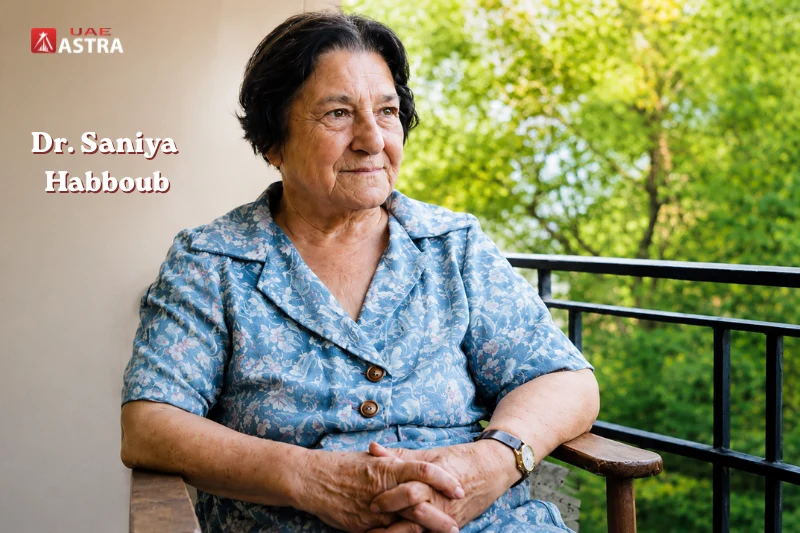
Dr. Saniya Habboub was one of the most influential figures in Lebanese medical history. She was one of the first Lebanese women to graduate from medical school abroad after getting her degree from the Woman’s Medical College in Philadelphia, PA, USA in 1931, when very few women were even studying higher education.
Returning to Beirut, she opened a medical practice and spent a great deal of her career working in gynecology and community service. As a physician, she went on to promote the future of women in medicine throughout Lebanon.
To this day, Dr. Saniya Habboub is respected as a trailblazer in medical training and in the empowerment of women. In 2022, her achievements were immortalized by a dedicated doodle by Google again.
Quick Facts About Dr. Saniya Habboub
| Fact | Details |
|---|---|
| Full Name | Saniya Moustafa Habboub |
| Birth Year | 1901 |
| Birthplace | Beirut, Lebanon |
| Profession | Physician |
| Medical Specialty | Gynecology and Obstetrics |
| Medical School | Woman’s Medical College of Pennsylvania |
| Graduation Year | 1931 |
| Historic Achievement | First Lebanese woman to study medicine abroad |
| Humanitarian Work | Lebanese Red Cross and community healthcare |
| Government Recognition | Health Medal of Merit (1982) |
| Death | 1983 |
| Global Recognition | Google Doodle (2022) |
Why Dr. Saniya Habboub Matters in Medical History
Much of the time, many pioneers are successful in their fields. Few trainers transform the expectations of an entire new generation.
Dr. Saniya Habboub chose a career in medicine at a time when women in Lebanon had many difficulties and obstacles to get into universities. The presence of medical schools was male-dominated, and women’s role in society was relegated to domestic duties.
Habboub, instead, strove for educational opportunity and women’s empowerment, taking his chances overseas, preceding these concepts as they entered the public discourse decades earlier. Her career can be considered an important period in the history of:
- Woman’s medical education
- Lebanese healthcare
- The rights of women in the Middle East.Middle Eastern women’s rights.
- Public health development
- Science-related female leadership
Today, the influence of her influence can be felt in Lebanon and the Arab region, especially in the rise of women physicians in many locations.
Early Life and Family Background
Dr. Saniya Habboub was born in Beirut into a Muslim family in 1901. Her father, Moustafa Habboub, was a leather merchant, and Adla al-Jazairy, her mother, was a very important influence on her ambitions for education.
A fascinating fact about her life was that her mother didn’t know how to read or write. Although she was never formally educated, she was greatly esteemed by educated women and demanded that her daughter’s education be a priority. This support was often mentioned as one of the reasons for Habboub’s later success.
As a youth in Beirut during the years of the last Ottoman regime and the period of the French Mandate, Habboub saw a society in the throes of great cultural and political shifts. There was a steady increase in educational opportunities for women, although they were few and far between in the professional fields, particularly medicine.
Education: Overcoming Institutional Barriers
Habboub pursued her education at the American Junior College for Women, one of the top educational institutions of the era for women in Lebanon. Later, she attended the American University of Beirut (AUB).
A big challenge, however, soon arose.
During this time period, women had not been involved in AUB’s medical program. For many, their dream as aspiring students to become doctors comes to an end. Habboub took another route.
Instead of giving up her dream, she chose to study medicine in the USA, something unheard of for a Lebanese woman in the 1920s.
Traveling Abroad for Medical School
Women from the area at the time were rare travelers abroad. It was even more unheard of to study medicine abroad.
This was the road Habboub embarked on, and the first Lebanese woman to be revealed as a student of medicine abroad. She attended the Woman’s Medical College of Pennsylvania, one of the finest institutions for the education of women physicians in the world.
Her achievement was not just a testament to her strength and resolve but also to her defiance of a set of firmly established societal expectations.
Medical Education in the United States
The Woman’s Medical College of Pennsylvania offered opportunities that were denied to many women of the time.
Habboub learned medicine with students from around the world and diverse backgrounds. The institution was renowned for its high standards of academic excellence and was a crucial institution for the training of female GPs, as many medical schools would not accept female applicants at this time.
In 1931, she graduated with her medical degree.
To this day, she was a historic graduate because:
- The first female doctor from Lebanon to be educated in a foreign country.
- The only Arab graduate in her class.
- One of the first Arab women to study at a higher level in medicine in the United States.
Upon graduation, she stayed on to pursue further clinical training in gynecology and obstetrics in the United States, further building her skill and knowledge base that would serve thousands of women in Lebanon.
Returning to Lebanon and Establishing a Medical Practice
Upon graduation and postgraduate training, Habboub moved back to Beirut in the early 1930s and opened her medical practice in Bab Idriss.
This was an unprecedented accomplishment.
She opened a practice in Beirut, the first woman doctor trained in foreign lands. At the time, many patients had never been treated by a female doctor, and some initially assumed she was merely a midwife rather than a fully qualified physician. She slowly earned the trust and recognition of people over the years.
Her clinical excellence and compassion were rapidly established in her practice.
Healthcare for Women Regardless of Income
A major theme throughout Dr. Habboub’s career was a dedication to underserved patients.
There are several historical records of her regularly giving free medical treatment to women who were unable to afford it. She also carried out home visits and spent much of her career serving the underserved communities.
This was particularly significant because many women in that time period were having to overcome economic, social and cultural obstacles to accessing healthcare.
Contributions to Women’s Health
Dr. Habboub’s specialty was gynecology and obstetrics, a specialty that was crucial in the era of modern healthcare, especially for mothers, which was in its infancy throughout the region.
Her work contributed to greater awareness and accessibility of:
| Area of Healthcare | Importance |
|---|---|
| Prenatal Care | Improved maternal health outcomes |
| Obstetrics | Safer pregnancy and childbirth care |
| Gynecology | Specialized treatment for women’s health issues |
| Preventive Medicine | Early diagnosis and intervention |
| Community Health | Increased healthcare accessibility |
With a highly trained female medical practitioner, a lot of women sought medical attention who would otherwise have ignored the issue.
In this way, her impact was felt not only with individual patients but with the general public in general, and she helped advance public health.
Humanitarian and Community Service
Dr. Habboub thought that medicine had a role to play in society.
She also had an active interest in human rights groups and community institutions, as well as her practice.
According to the sources, she worked for the Lebanese Red Cross, providing medical assistance and participating in various health-related activities. She also linked with all organizations working to involve women, children and vulnerable groups.
She served the community in many ways:
- The Lebanese Red Cross
- Muslim Orphans’ Home
- Young Women’s Muslim Association
Maqassed Hospital leadership activities and community work are closely linked. There is a strong linkage between Maqassed Hospital activities and community work.
A Pioneer for Women in the Arab World
one of the pioneers for women in the Arab world.
It is even more impressive to contemplate Dr. Saniya Habboub’s accomplishments in history.
In much of the Middle East, opportunities for women in science, medicine and higher education were exceedingly minimal during the early twentieth century.
Acquiring a medical education in an overseas institution and establishing a compelling career, Habboub helped to defy prevailing notions of women’s abilities and career trajectories.
Her success was a strong message:
Women could gain the highest professional standing, put in their contribution to society, steer institutes and become successful doctors and scientists too.
The value of her contributions to the overall history of the development of Arab women’s education and health care is recognized by many historians and educators.
Recognition and Honors
Dr. Habboub was honored for her service to the medical and humanitarian communities over the years.
Health Medal of Merit
In 1982, she received the Health Medal of Merit from the Lebanese Government for fifty years of service as a physician. This honor was her great commitment to health and social service.
Scholarship Legacy
In honor of the institution that allowed her to gain her education, Habboub founded a scholarship that is linked to the Woman’s Medical College of Pennsylvania. The scholarship program assisted future generations of young students when it came to getting their medical education.
Beirut Street Named in Her Honor
Her contributions are alive in Beirut, as a street in Ramlet al-Baida of Beirut is named after her.
Google Doodle and Renewed Global Recognition
Dr. Saniya Habboub was also honored with an official Google Doodle on June 10, 2022, to mark her medical school graduation.
The Doodle commemorated her trailblazing contribution to:
- Women’s medical education
- Lebanese healthcare
- Humanitarian service
- Women’s career development
The tribute brought the recognition and appreciation of her achievements to a global stage and reignited interest in her achievements in the field of medicine and history among historians, students, and healthcare workers.
Lasting Legacy
It is four decades later in time and space since her demise in 1983 that Dr. Saniya Habboub is still one of Lebanon’s most reputable medical pioneers.
Her legacy lives on partly because she connected to a number of perennial themes:
Working towards the good of opportunity – education. Healthcare as a community service. Value of excellence combined with care. The faith that things can be achieved by hard work and perseverance.
Many of the issues raised in recent conversations about women in STEM and equality in education and health care stem from problems faced by women pioneers like Habboub many generations ago.
Her life is a testament to the idea that progress often starts with people with guts to take the chances that others deem impossible.
Conclusion
With determination, expertise, and service, Dr. Saniya Habboub helped to shape Lebanese medical history. She was the first woman from Lebanon to study medicine in a foreign country, thus setting new records for opportunities for women to enter professional fields and higher education. Her efforts in community care, humanitarian efforts, obstetrics and gynecology treatments and progressive advancements in medicine affected the lives of countless women, inspiring generations of women to become doctors.
She is still relevant to us today because her story is more than the sum of its parts; it is a story about British Women. This captures the influence of education, the significance of healthcare availability and the effect that one forward-thinking person can make on a whole society. Battling the odds with her accomplishments made Dr. Saniya Habboub one of the most prominent in Lebanese medical history.
Read Also:
Asma Hamza and the Cultural Legacy of Sudanese Music in the UAE
Ousha Al Suwaidi Biography, Poetry, Legacy & UAE Cultural Impact
Frequently Asked Questions
Who was Dr. Saniya Habboub?
Dr. Saniya Habboub was a Lebanese physician and the first female Lebanese to study medicine abroad and graduate from Lehigh University’s Woman’s Medical College of Pennsylvania.
When was Dr. Saniya Habboub born?
Born in Beirut, Lebanon, in 1901.
Why is Dr. Saniya Habboub famous?
She is renowned for being the first Lebanese female student in medicine studies abroad and the first to introduce women’s healthcare in Lebanon.
Where did Dr. Saniya Habboub study medicine?
She was educated at the Woman’s Medical College of Pennsylvania, U.S.A.
What was her medical specialty?
Her advanced training was in gynecology and obstetrics.
Did Dr. Saniya Habboub offer free medical care?
Yes. Historical records show that she rendered many services to underprivileged women without any charge, and also offered free services through her clinic as well.
Was Dr. Saniya Habboub involved in humanitarian work?
Yes. She collaborated on various projects with the Lebanese Red Cross and other non-governmental organisations for women’s and children’s causes.
What award did she receive from the Lebanese government?
In 1982, she was awarded the Health Medal of Merit for 50 years of service.
Why did Google create a Doodle for Dr. Saniya Habboub?
She was honored by Google in 2022 for her contributions and pioneering contributions to the medical field and women’s education and health.
Is there a street named after Dr. Saniya Habboub?
Yes. A street in Ramlet al-Baida, Beirut, is named after her.
What impact did Dr. Saniya Habboub have on women in medicine
She was proof that women are capable of advanced medical studies and working in advanced healthcare professions, which encouraged future women doctors in Lebanon and other Arab countries.