
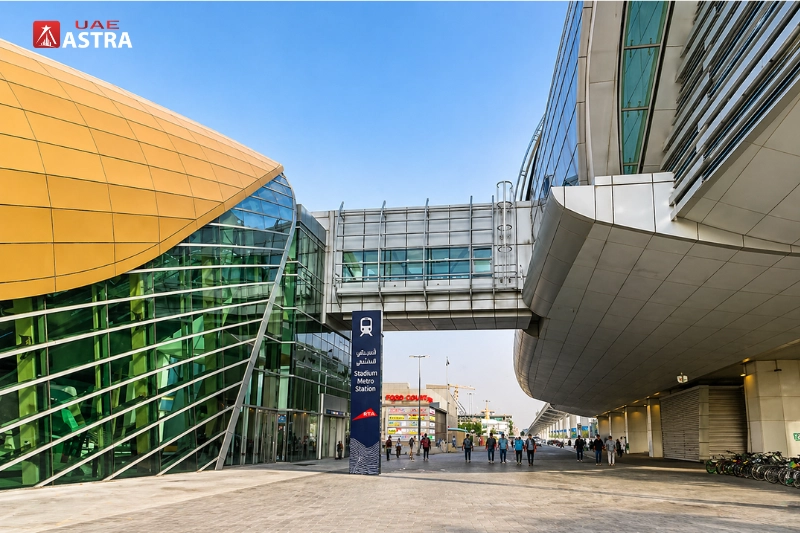
The Stadium Metro Station is an excellent location on the Dubai Metro, and the commuters are distributed throughout Dubai. It is situated in a busy urban area, linked by a good metro system to residential areas, business districts, and government buildings.
To people who use it daily and to novices, information on how this station operates, where it is, when it operates, and where it goes can help make their transportation more effective and foreseeable.
Overview of Stadium Metro Station
This is the Stadium Metro Station that commutes on the Red line, which is the heart of the metro in Dubai. It is managed by the roads and transport authority, which has been mandated with the responsibility of ensuring the integrated transport services in the city.
The station caters to the Al Qusais district in particular and is busy with passengers the whole day long. It is also an option that is convenient since it will be used by those individuals who will be required to commute between residential and central business districts.

Location and Geographic Importance
Where the Station Sits in Dubai
The station site lies in an established locality, Al Qusais, eastern Dubai, which is not only residential but also has industrial activities. It provides easy access to other local areas such as Deira and Al Nahda, and hence, it may be an excellent transit point when travelling short and medium distances.
Nearby Landmark Influence
One of the landmarks in the area is the Al Ahli Stadium, which is home to the Shabab Al Ahli Club. This enhances the number of passengers during match days and events, which contribute to the functional significance of the station.
Dubai Metro Red Line Connectivity
Dubai is serviced by the Red Line Dubai Metro that links large areas of the city, such as airport areas, commercial hubs, and residential areas. The Stadium Metro Station is situated along this path, with accessible accessibility in either direction.
Passengers going to Centrepoint can access areas accessible by the airport and surrounding communities, and the opposite way links to central and western Dubai, business and tourist attractions.
It is not a transfer station, but it also links together the exchange stations, such as Union and BurJuman, easily.

Train Timings and Schedule
The Dubai Metro has a systematic timetable with the Roads and Transport Authority. Although timings overall are the same, detailed direction-based timetables are more effective for the commuters.
Towards Creek (City Centre Direction)
| Day | First Train | Last Train |
| Monday–Thursday | 5:00 AM | ~12:00–12:05 AM |
| Friday | 5:00 AM | ~1:00–1:05 AM |
| Saturday | 5:00 AM | ~12:00–12:05 AM |
| Sunday | 8:00 AM | Near Midnight |
Towards Centrepoint / Etisalat Direction
| Day | First Train | Last Train |
| Monday–Thursday | 5:14 AM | ~12:00–12:05 AM |
| Friday | 5:14 AM | ~1:00–1:05 AM |
| Saturday | 5:14 AM | ~12:00–12:05 AM |
| Sunday | 8:14 AM | Near Midnight |
Such timings portray the normal running of the metro. The precise departure times can be slightly different due to the conditions of the services.
Fare System and NOL Card Usage
The Dubai Metro adopts a zone-based fare system, which is run under the Nol card. The fare is paid depending on the number of zones covered, and thus, distance fares are proportional.
| Travel Range | Fare Level |
| Within one zone | Lower fare |
| Two zones | Moderate fare |
| Three or more zones | Higher fare |
The Nol card is available in station machines and counters, where it can be bought or reloaded so that it can be used continuously without any problems during travelling in the metro and buses.
Facilities and Passenger Experience
The station is meant to accommodate the current transit standards. Platforms are air-conditioned, and vertical movement is facilitated with the use of escalators and elevators. Good signage guarantees easy movement of both residents and tourists.
The station design has accessibility features like wheelchair accessibility and guide paths of tactile guidance. The surveillance systems, platform screen doors, provide safety, and the travel environment is controlled.

Transport Connectivity and Bus Routes
The network also reaches beyond the metro line through feeder and intercity buses, which connect the station to the adjacent areas.
Feeder Bus Routes
- F22 links to Qusais Industrial Area
- F23 is connected with the Al Nahda residential areas
- F23A offers more coverage in Al Nahda
- F24 is linked to industries and business localities
Intercity and Additional Routes
- E308 links to Al Jubail Bus Station, Sharjah.
- 64A connects Gold Souq and Ras Al Khor.
- C28 links Mamzar Beach Park with Deira.
- Gold Souq is linked with Al Qusais through 13A and 13B.
These routes make the station a multi-layered transport hub.
Travel Options and Time Comparison
Knowledge of travel can assist commuters in choosing the best alternative that is more efficient.
| Mode | Approx. Time | Cost (AED) | Notes |
| Metro | ~25–30 mins | 8–11 | Fast and reliable |
| Bus | ~45–60 mins | 8–13 | Multiple route options |
| Taxi | ~15–20 mins | 40–55 | Faster but higher cost |
| Car | ~15–20 mins | 7–10 | Parking may apply |
The most predictable means of commuting is the metro because of the constant time and price.

Additional Facilities and Commuter Support
The station has additional supportive features besides the core transport functions that enhance usability daily.
- Small convenience stores and retail kiosks
- Quick transactions via ATM
- Passenger guidance information counters
- Ordered waiting bays
These facilities are ones that are compatible with the standards of the Roads and Transport Authority and will guarantee the same user experience on the network.
Why Stadium Metro Station Matters for Daily Travel
Stadium Metro Station is not merely a transit station. It promotes movement throughout Dubai, both in the daily routine, linking residential areas to business and event venues.
- Accessibility to residents in Al Qusais.
- Dependable Red Line service throughout the city.
- Proximity to Al Ahli Stadium.
- Combination with buses and taxis.
- Regular service frequency during the day.
These aspects render it reliable in the transport infrastructure of the city.

How to Reach Stadium Metro Station
Users who are flying out of Dubai International Airport can take the red line and arrive at the station directly. Individuals who are on the road find it easy to move in the reverse direction without making numerous transits, especially those who are in the central locations, including Downtown Dubai.
The station is also well accessible from most areas of the city due to the metro line it is located on.
Travel Tips for Efficient Use
One way to enhance comfort is to plan to travel during off-peak times. Also, maintaining a satisfactory NOL card balance ensures one does not have to spend a lot of time at the entry gates. By practising metro etiquette, such as seating arrangement and keeping clean, everyone will enjoy the ride.
Conclusion
The Stadium Metro Station Dubai is an effective and trustworthy transit station in the transport network of Dubai. Its great connectivity with the Red Line and the combination of bus services, as well as the position in Al Qusais, make it both a daily commuter and an occasional destination.
The station, with its organised routes and schedules and facilities that are easy to access, is indicative of the efficiency of the public transport that is present in Dubai and satisfies the required needs of a wide variety of clients.
Must Read Our Overview On DMCC Metro Station and ADCB Metro Station.
Frequently Asked Questions
Where is Stadium Metro Station located?
It is in Al Qusais in Dubai on the Red Line.
Which metro line serves it?
It belongs to the Dubai Metro Red Line.
What are the operating hours?
Metro usually operates early mornings until about midnight (and longer on Fridays).
Is it near a major landmark?
Yes, it is close to Al Ahli Stadium.
How are fares calculated?
The price varies according to the number of zones one has travelled by the Nol card system.