







Though you may find a modern luxury car to be quite smooth and easy to drive, it’s the result of several systems working hard in the background. There can be a number of warning indicators that may not be connected to a minor sensor issue. This is because the data from the sensors is transmitted to the control units, which control several parts of the car. The sensor may provide inaccurate data to the engine’s computer, the automatic transmission, or the safety system, resulting in decreased performance, warning lights, harsh shifting, or abnormal fuel consumption.
It can also involve multiple interdependent systems due to the fact that all modern cars are interconnected with a number of control units sharing data. Symptoms may be even more difficult to trace due to faulty wiring, weak sensor signals, heat damage, moisture, software errors, and poor electrical supply.
How Can a Sensor Fault Affect Different Car Systems?
One sensor is not necessarily in charge of one part of a car. It can be simultaneously read from multiple electronic control units. For instance, air pressure, temperature, wheel speed, and engine speed data might enable various systems to determine what to do with the vehicle. Other systems may respond to false information provided by one sensor. That’s why a sensor problem may present symptoms that seem completely unrelated. A technician working in car repair in Abu Dhabi may need to check the sensor, wiring, control modules, and stored fault codes instead of replacing the first part that shows an error.
1. Wrong Data Can Change Engine Performance
Precise information is essential to the engine for controlling fuel delivery, ignition, airflow, and other processes. The sensors gauge conditions like the temperature of the air, the temperature of the engine, air pressure, and oxygen. When a sensor sends out the wrong data, the engine control unit can adjust itself and compensate for it.
This can result in slow acceleration, rough running, difficulty starting, poor fuel economy, or inconsistent power. Even if the problem is a mis-signal from a sensor, the driver may assume that something is seriously wrong with the engine. You can check the sensor and compare its reading to the expected value to find the actual problem.
2. A Sensor Can Trigger Warning Lights
Modern luxury vehicles have a number of warning lights as their control systems constantly monitor vehicle data. If the sensor reading is out of the normal range, the sensor control unit will set up a fault code and activate a warning light. The warning light may indicate a problem with the system, but not necessarily with the specific component that is failing. For instance, a warning on an engine could be due to a sensor, wiring, or a problem with the power supply. That is why it is essential to read the fault code as the first step. Correct testing is required to determine the cause of the warning.
3. Faulty Wheel Sensors Can Affect More Than Braking
Wheel speed sensors play a vital role in systems like ABS, traction control, and electronic stability control. They determine the speed of each wheel and inform the car’s computer systems.
If one sensor reads incorrectly, then the car can think that one wheel is slipping when it isn’t. This may trigger warning lights, variation in the traction control performance, or strange alerts in the braking system. This issue may also cause some cars to restrict some driving functions until the condition is corrected. Similar symptoms can be caused by damage to the sensor, a broken wire, a dirty sensor area, or a damaged tone ring.
4. Temperature Errors Can Change Vehicle Behavior
The temperature sensors enable the car to understand the temperature of the important components. The temperature information is used in the engine control systems to tune fuel, cooling, etc. Temperature information can also be used for transmission and battery systems.
This can result in multiple symptoms if the reading is faulty. The wrong signal from the engine temperature sensor can cause starting problems, improper idle speed, operating the cooling fan, or fuel consumption. The control system can also switch to a protection mode in some vehicles if it receives unsafe data. It can be helpful for a technician to verify the temperature against the sensor to distinguish between sensor and true overheating.
5. Pressure Sensors Can Create Performance Problems
There are a number of pressure sensor applications in modern vehicles. They are able to monitor intake air pressure, fuel pressure, exhaust pressure, or other operating conditions in the vehicle, depending on the vehicle. These readings are used by the control unit to determine how the vehicle is to be operated.
Any overshooting or undershooting signal coming from a pressure sensor can cause the control system to make an incorrect adjustment. This can lead to slow acceleration, sluggish engine response, higher fuel consumption, or warning lights. Sometimes a pressure sensor fault can be confused with a blocked filter, air leak, fuel issue, or turbocharger fault. Inspecting the sensor signal and hoses may help determine the true cause.
6. Faulty Sensors Can Cause the Car to Enter Safe Mode
Luxury cars are engineered to safeguard critical systems when they detect data indicating a serious issue. If a sensor is out of safety range or doesn’t send a signal, the control unit can restrict the amount of power the engine can deliver, transmission operation, or other activities.
Drivers might experience poor acceleration, a restricted range of gears, or a dashboard message. This is sometimes referred to as “safe mode” or “limp mode”. Although the car looks like it has a big problem, the problem could be related to an electrical or sensor issue. A correct scan and system test can aid the identification of the cause of the protection mode.
7. Wiring Problems Can Look Like Sensor Failure
The sensor could be okay, but the wiring could be an issue. The signal from the sensor to the control unit may be lost due to broken wires, loose connections, corrosion, water intrusion, or poor electrical contact.
This can cause a healthy sensor to seem like it is broken when performing a simple scan. Another circuit may also have the same wiring problem and have several warning lights and odd symptoms simultaneously. Typical tests done by a technician for the sensor include checking the power supply, the ground, the signal voltage, the condition of the connector, and the continuity of the wiring. Knowing what is wrong with your wiring could save you money and parts rather than replacing the sensor.
8. Shared Data Can Confuse Several Control Units
Contemporary luxury vehicles have communication networks to enable the exchange of information between the control units. While driving, the vehicle can share information with the engine, transmission, brakes, steering, body, and safety systems.
If one sensor reports bad information, then this network can propagate inaccurate information. A second control unit may then record a fault due to receiving an incomprehensible message. This means that several warnings can appear on the dashboard simultaneously. This is not necessarily an indication that multiple parts are broken. Sometimes, multiple alerts can be the result of one input failure or communication issue.
9. Heat and Moisture Can Damage Sensor Signals
Sensors work in challenging locations of the car. Others are near the engine, exhaust system, wheels, or any other heat and moisture source. Sensors and connections can be impacted by high temperatures, water, dirt, vibration, and road debris over time. A sensor can function perfectly fine in the cold conditions of a vehicle but fail in the heat conditions of the vehicle. There are also temporary electrical issues that would only be apparent during an inspection if the moisture problem was present.
That is why you may need to have your car tested by a technician under different circumstances. The stored fault code might not be sufficient to determine the problem.
How Do Technicians Find the Real Sensor Problem?
Anytime you see a sensor fault, you can’t just change the component indicated in the scan, since you may be changing the wrong part. Codes that are stored and live data can be displayed in a diagnostic scan; however, the diagnosis must be interpreted in the proper context.
The proper inspection can involve:
- Reading fault codes: Checks which control units have detected unusual signals.
- Checking live data: Compares current sensor readings with normal operating values.
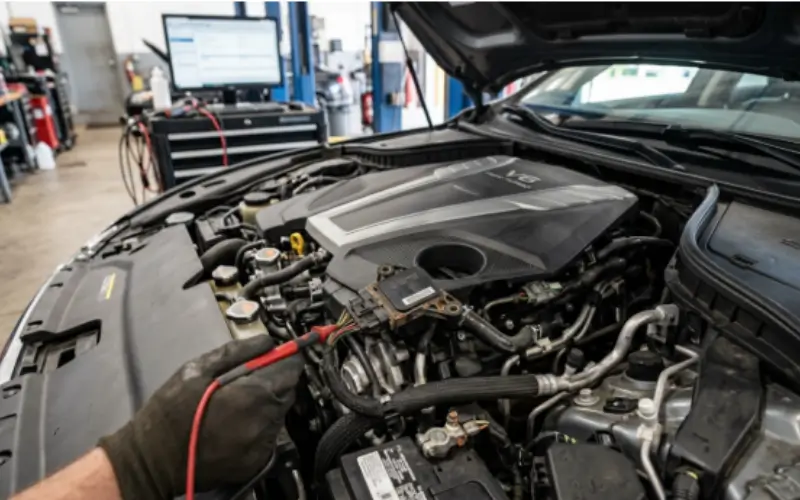
- Testing wiring: Looks for breaks, poor connections, corrosion, or short circuits.
- Checking power and ground: Confirms that the sensor receives the correct electrical supply.
- Inspecting related parts: Rules out mechanical problems that could create similar readings.
- Road testing: Helps confirm when and how the symptom appears.
This is a sequential procedure that minimizes the likelihood of substituting parts when the cause of the problem has not been addressed.
Conclusion
Modern luxury cars are built around a number of interconnected electronic systems, so that a malfunctioning sensor may result in unrelated symptoms. The operation of the engine, gear changes, brake functions, warning lights, fuel consumption, and engine safe mode operations are all affected by the incorrect sensor readings. The issue can be even more difficult to diagnose if heat, moisture, damaged wiring, weak electrical connections, or communication faults make it so. The focus is on looking at the message, but now on testing the entire system.
If the sensor fails, it can be determined if the problem is due to a faulty sensor, wiring, or even a mechanical issue, eliminating the need for unnecessary part replacement. If multiple symptoms manifest simultaneously, timely car repair is needed. Service support can be useful to determine the cause of the problem before it gets out of hand.
Read Also: Al Quoz Mall Dubai