

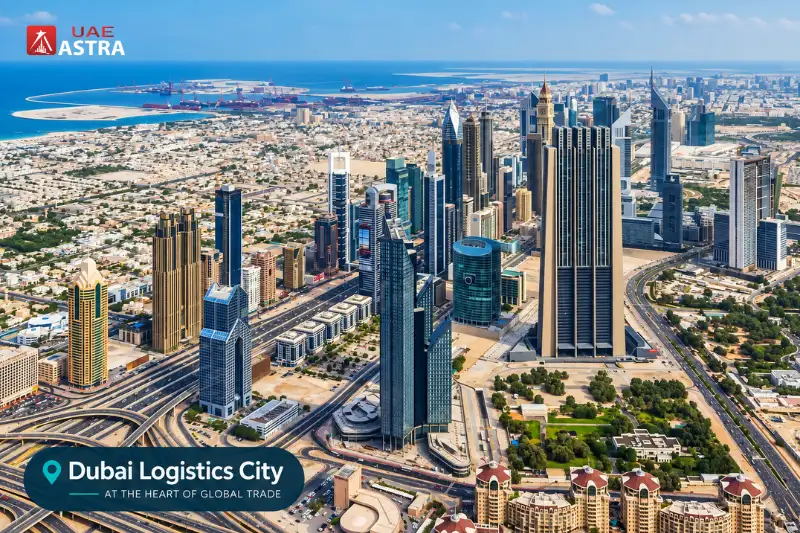
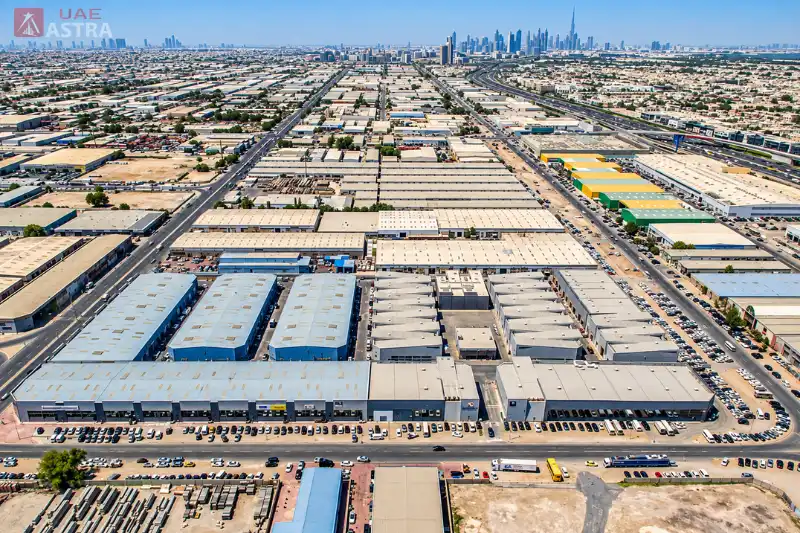
Dubai Logistics City is the logistics-focused area within Dubai South, built around freight, warehousing, distribution and supply-chain operations. The area is closely connected with Al Maktoum International Airport, Jebel Ali Port and major road networks, making it part of Dubai’s wider multimodal logistics infrastructure. Dubai South’s current official terminology generally refers to the area as the Logistics District, although the name Dubai Logistics City remains widely used in business and facility references.
The district is intended for companies that require more than a warehouse. It’s part of a supply chain ecosystem comprising freight forwarding, contract logistics, e-commerce, fulfilment, specialised cargo handling and customs services. The mix makes the site especially significant for businesses transiting via air, sea and road transport.
Dubai Logistics City Location
Dubai South is situated around Al Maktoum International Airport (DWC) and is home to Dubai Logistics City. It is also located near Jebel Ali Port, which has a bonded logistics corridor as well as access to the UAE’s main road network.
This is a significant site as logistics operations are frequently dependent on the speed at which the cargo can be transported between different modes of transport. In a networked scenario, a warehouse can be located in the middle of the network and receive goods by air, sea, or road without being cut off from the other components of the supply chain.
Main Transport Connections
The district’s key connections include:
- Al Maktoum International Airport for air cargo
- Jebel Ali Port for sea freight
- UAE road network for inland distribution
- Bonded logistics corridor linking the port and logistics ecosystem
Dubai Airports says that DWC has dedicated cargo terminals and a bonded road connection to Jebel Ali Port, which is dedicated to sea-to-air cargo movement.
The Role of Dubai South Logistics District
Dubai South is the development, with the specialised logistics part known as the Logistics District. This distinction is helpful as businesses conducting searches for Dubai Logistics City might stumble upon both names when seeking warehouses, companies, facilities, or commercial space.
Logistics areas in the district, as opposed to one logistics area. Dubai South’s logistics infrastructure includes the Freight Forwarding Zone, EZ-Dubai e-commerce zone and Contract Logistics Zone.
This is the format in which various kinds of logistics companies can function as per their requirements. For instance, a freight forwarder doesn’t have to have the same facilities as a chemical specialist logistics provider or an e-commerce fulfilment company.
Logistics Facilities and Warehouse Space
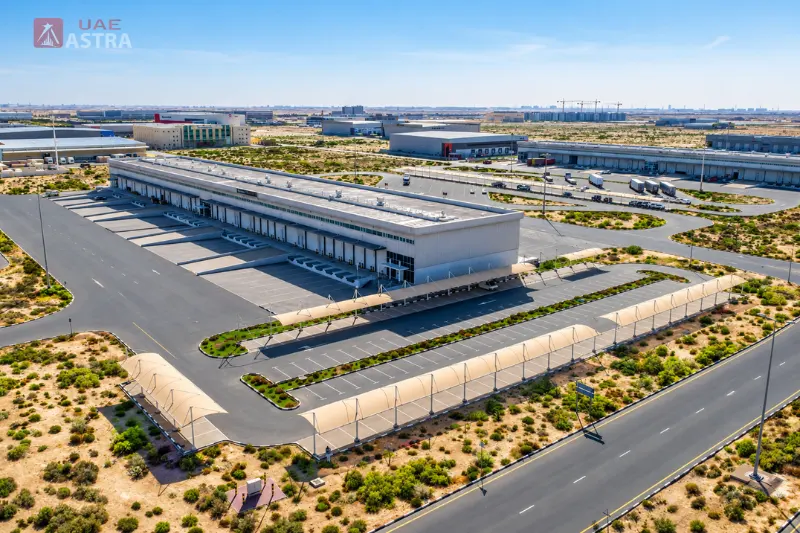
One of the district’s primary duties is to support the warehouse infrastructure. Dubai South has been developed with facilities for both big logistics operators and smaller-sized businesses with flexible space needs.
Multi-user facilities of recent construction are about 215,278 square feet, including combinable units, ground-level access and temperature-controlled units. According to Dubai South, these facilities are designed for SMEs, logistics companies, e-commerce businesses, traders and businesses engaged in international trade.
The district also provides space in larger purpose-built buildings for companies with special requirements.
Flexible Units
The multi-user facilities consist of two units of about 2,152 square feet and a two-unit of 3,767 square feet with the potential to expand upon each other. This allows smaller operators to be more flexible than signing a long-term contract for a single, large warehouse.
Other warehouse specs from Dubai suggest that units start from about 190 sq m with expandable, level access doors and an 8-metre eaves height.
Large Logistics Facilities
The district also has large facilities for larger operators. Expeditors, for instance, established a base of around 23,200 square metres to house their warehousing, fulfilment and container freight station business. Its services include inventory management, order management, pick-and-pack, labelling, kitting and transportation management.
Facility sizes indicate a mix of sizes, not only logistics companies.
Freight Forwarding and Contract Logistics
Freight forwarders play an integral part in the district’s mission. Companies that engage in this activity arrange the transportation of goods from suppliers to carriers, to ports, airports and to their destination.
The Contract Logistics Zone further contributes by enabling businesses that are willing to entrust their warehousing and supply-chain requirements to the specialists. This is applicable for companies that are not interested in maintaining a full logistics network.
Overall, these functions allow companies to potentially control multiple points of the supply chain in a single overall logistics system, rather than having to coordinate each function at separate locations.
E-Commerce Infrastructure
Dubai South has a special role to play in e-commerce, as it is known as the Dubai e-commerce free zone (EZDubai).
The requirement for e-commerce logistics is different from conventional bulk storage. Online stores have to have inventory management systems, order processing, order picking, order packing, returns and delivery coordination systems. The district’s facilities thus offer fulfilment and traditional warehousing services.
The location benefits of an e-commerce business are the combination of storage and fulfilment capabilities with access to freight and distribution networks.
Air Cargo at Al Maktoum International Airport
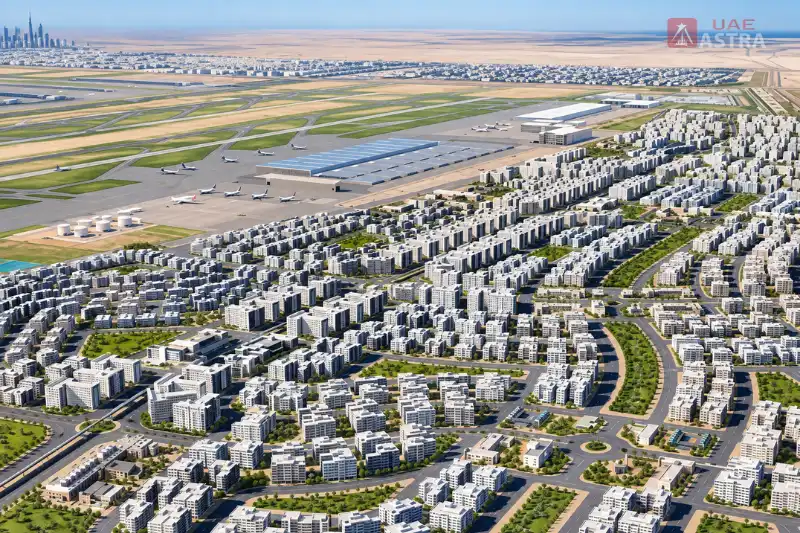
Al Maktoum International Airport is one of the logistics facilities that surround the district.
According to Dubai Airports, Dubai World Airport (DWC) has a processing capacity of around 800,000 to 1.2 million tonnes of cargo annually and is equipped with dedicated cargo terminals. It also has a sea-to-air bonded road link to Jebel Ali Port.
The airport accommodates several categories of cargo (general cargo, pharmaceuticals, temperature-controlled products, perishables, etc., valuables and dangerous goods), depending on the type of cargo and the handling arrangements and requirements.
With the availability of this infrastructure, companies with air freight needs can shorten the distance between the warehouse function and the airport cargo operations.
Jebel Ali Port Connection
Jebel Ali Port is the other significant transport link.
The Logistics District is connected to Jebel Ali Port with a bonded logistics corridor, says Dubai South. Additionally, Dubai Airports also states that Jebel Ali Port has a dedicated bonded road for the connection between Jebel Ali Port and DWC.
Especially for companies with multiple methods of transport. The cargo can be delivered along the sea-freight network and then flow into the larger logistics network for warehousing, distribution, or air freight.
It is not just geographical significance, but operational – the district is part of a joined-up air-sea-road freight network.
Customs Services
Another key component of the region is its customs infrastructure.
The Dubai Logistics City Inspection Center is one of Dubai Customs’ inland centres. Additionally, it mentions a Dubai Logistics City Customer Service Center.
According to its published service information, Dubai Customs’ Dubai Logistics City (DLC) Inspection Center conducts customs inspection, goods release and inspection-related services and the Dubai Customs customer service center facilitates relevant customs services and documents.
This is especially true for businesses whose operations are dependent on goods that are being imported, exported, or re-exported, as customs is an integral component of international shipment.
Customs Should Not Be Confused With Warehouse Services
The presence of a customs centre within the logistics environment does not ensure that all the customs services will be rendered in all the warehouses.
Customs needs vary depending on the goods, the declaration, the movement and the rules and regulations. Therefore, Dubai Customs and their designated logistics service provider should be contacted to verify the exact customs procedure prior to the movement of commercial goods.
Types of Businesses in the Area
The district has a wide variety of logistics-related businesses.
Common categories of businesses are:
- Freight forwarders
- Third-party logistics providers
- Warehousing companies
- E-commerce operators
- Traders
- Distribution businesses
- Fulfilment companies
- Healthcare logistics providers
- Specialised cargo operators
- Companies handling regulated goods
This diversity is illustrated by some recent developments. TLM Logistics has opened a large chemical logistics facility; Expeditors has opened facilities based on warehousing and fulfilment. Dubai South has also announced facilities with UPS and Toll Group.
This combination renders the district attractive for companies owning and managing their supply chain as well as for companies outsourcing their logistics tasks.
Specialised Cargo Capabilities
Not every type of logistics includes basic palletized items. Some need a controlled environment, special safety systems, or special handling procedures.
This site in this district is about 465,000 square feet and is designed to have infrastructure for dangerous and non-dangerous goods. The site is equipped with segregated air-conditioned dangerous goods chambers, special racking and warehouse-management systems.
Other services it provides are freight forwarding, customs clearance, labelling, bar coding, palletisation and repackaging.
This is a testament to the importance of choosing a facility to fit cargo and not size or location.
Current Expansion of the District
New facilities and investments in logistics are still flowing into the Logistics District.
One significant development is the planned Toll Group distribution centre, which will occupy an area of around 25,000 square metres and will accommodate 30,644 pallets. The facility will be capable of offering 3PL services, stock handling, value-added services and local and cross-border transportation and will be completed in August 2026, according to Dubai South.
Dubai South has also announced the opening of a new UPS facility that will give UPS expanded capacity and build the international trade network.
The projects demonstrate that the district is still expanding its logistics capabilities, not as a permanent group of pre-established warehouses.
Who Can Use Dubai Logistics City?
The district can accommodate businesses in various stages, but it depends on the nature of the business model.
SMEs and Smaller Operators
A small number of smaller companies can benefit from flexible multi-user facilities, instead of having a large dedicated distribution centre. Recently, Dubai South has placed special emphasis on the multi-user units it offers for SMEs, traders, e-commerce businesses and logistics companies.
Large Logistics Companies
Purpose-built facilities can be built around high-volume warehousing, high-volume fulfilment or specialised cargo, or regional distribution for large operators.
The presence of companies like Expeditors’ operations and the planned Toll Group centre reflects the scale that is available for larger logistics operations.
Businesses With Special Cargo
Firms that need to deal with chemicals, pharmaceuticals, or other regulated goods must have the appropriate technical and regulatory standards. The TLM facility shows the possibility of providing specialised logistics infrastructure within the district.
Choosing the Right Facility
The worst thing that can happen when assessing Dubai Logistics City is to see each warehouse as an equal.
The facility must be representative of the company’s true cargo and supply-chain needs. Important factors include:
- Required warehouse size
- Temperature-control requirements
- Cargo classification
- Arrangements for loading and unloading.
- Customs requirements
- Storage systems
- Fulfilment requirements
- Road distribution needs
- Air-freight requirements
- Sea-freight requirements
- The need for value-added services.
The needs of a business dealing with ordinary consumer goods are unlikely to be the same as those that have to deal with pharmaceuticals and dangerous goods. This means that the available infrastructure needs to be evaluated and assessed based on how the site is used.
Dubai Logistics City Name and Dubai South
The terms are confusing as Dubai Logistics City and Dubai South Logistics District are tightly coupled.
Dubai South is the broader Master Development. It contains the specialised logistics area called Logistics District. Dubai Logistics City is still present in company addresses and existing facility references; Dubai South is being used for the current communications of the Dubai Logistics District.
Both terms can hence be of interest in a business search. In a warehouse check of a company/ building, the area name should be followed by confirmation of the exact building and/or the company.
Why the Location Matters for Supply Chains
The best aspect of the district is its linking of various phases of freight transport.
The business may need goods delivered to them via Jebel Ali Port and then placed in a warehouse and then ordered and distributed on the road. Other businesses can transport time-sensitive goods via DWC. A third may be involved in both freight forwarding and fulfilment and customs services.
Different supply-chain models are the basis for the district’s infrastructure. Therefore, its value lies in the relationship between warehousing and customs functions, air cargo & sea freight & road distribution functions and not in any one of them.
Key Points for Businesses
Before selecting a warehouse or logistics provider in the region, companies must check that:
- Exact facility location within the Logistics District
- Warehouse specifications
- Cargo handling capability
- Temperature-control availability
- Customs arrangements
- Available logistics services
- Loading and access requirements
- Lease or service terms
- Current availability
- Required business and cargo approvals
These details may differ from operator to operator and details on one facility should not automatically be used on another.
Conclusion
Dubai Logistics City is the Logistics Environment related to the existing Logistics District in Dubai South. It is a hub consolidating warehousing, freight forwarding, contract logistics, e-commerce, customs and specialised cargo operations, with links to Al Maktoum International Airport and Jebel Ali Port facilitating multimodal freight movement.
The most crucial point for businesses is the alignment of the facility with the supply-chain requirements. The size of the warehouse is not the only consideration; the type of cargo, customs requirements, temperature control, fulfilment, transport connections and specific handling should be checked before choosing a facility.
Must Explore: Al Muraqqabat Dubai Beyond the Map: History, Growth and Daily Life
How Jumeirah Islands Dubai Became One of the City’s Most Desired Addresses
FAQs
What is Dubai Logistics City?
It is the logistics sector linked to Dubai South’s Logistics District to provide services for warehousing, freight, distribution and supply chain.
Where is Dubai Logistics City?
Dubai South is located close to Al Maktoum International Airport and Jebel Ali Port.
Is Dubai Logistics City part of Dubai South?
Yes. The official term for Dubai South is currently Logistics District and is part of the Dubai South development.
Is there a Dubai Logistics City customs centre?
Yes. Dubai Customs provides the Dubai Logistics City Inspection Center and a Dubai Logistics City Customer Service Center.
Does it have warehouse facilities?
Yes. There are flexible multi-user units and large facilities for major logistics operators and specialised companies of cargo.
Is it connected to Jebel Ali Port?
Yes. The bonded logistics corridor is located in Dubai South for access to Jebel Ali Port.
Is Al Maktoum Airport nearby?
Yes. The Logistics District is located next to the airport’s cargo ecosystem, which includes dedicated cargo terminals and a bonded road connection to Jebel Ali Port.
Who uses Dubai Logistics City?
Users are logistics service providers, freight forwarders, e-commerce companies, traders, fulfilment operators, warehouse companies and specialized cargo businesses.