





Ask any founder who restructured a Dubai company two years in, and they’ll tell you the same thing: the free zone versus mainland decision felt simple at the start and expensive later. It’s a pattern chartered accountant firms in Dubai see constantly. An entrepreneur picks a structure based on a licence price or a “0% tax” headline, then discovers the rules don’t work the way the brochure implied.
The stakes keep rising. Dubai attracted a record 1,117 greenfield foreign direct investment projects in 2024, according to the Dubai Department of Economy and Tourism (2025). Thousands of those investors faced this exact fork in the road. This article breaks down how the two structures actually differ on tax, market access, and compliance and where each one genuinely fits.
What Actually Separates a Free Zone Company From a Mainland Company?
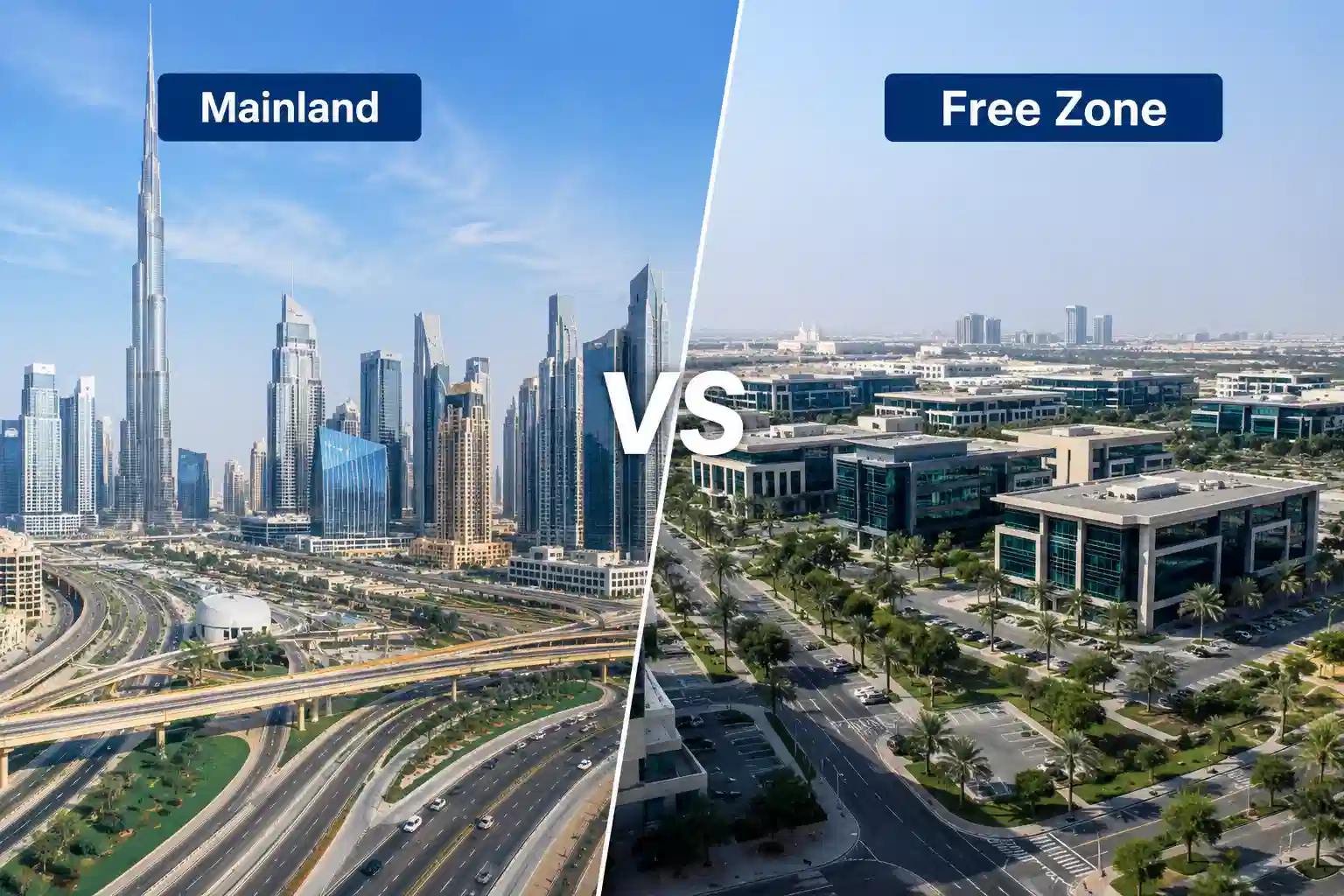
A mainland company is licensed by the Dubai Department of Economy and Tourism (DET) and can trade anywhere in the UAE. A free zone company is licensed by one of Dubai’s roughly 30 free zone authorities and operates within its zone and internationally, with restricted direct access to the local market.
That’s the short version. The practical differences run deeper:
| Factor | Mainland | Free Zone |
| Regulator | Dubai DET | Individual free zone authority |
| UAE market access | Full, across all emirates | Limited; local distributor or branch usually needed |
| Foreign ownership | 100% for most activities | 100% |
| Corporate tax | 9% above AED 375,000 profit | 0% on qualifying income only; 9% otherwise |
| Government contracts | Eligible | Generally not eligible directly |
| Office requirement | Physical office typically required | Flexi-desk and virtual options common |
One old distinction has largely disappeared. Since the UAE amended its Commercial Companies Law, foreign investors can own 100% of a mainland company in most activities, no local sponsor holding 51%. That change removed the single biggest historical reason to default to a free zone.
Why the “Free Zones Are Tax-Free” Assumption Costs People Money
This is where accountants spend most of their time correcting expectations. Since June 2023, free zone companies fall fully within the scope of UAE corporate tax. The 0% rate isn’t automatic; it applies only to a Qualifying Free Zone Person (QFZP) and only on qualifying income, as set out by the UAE Ministry of Finance under Federal Decree-Law No. 47 of 2022.
Holding QFZP status means meeting every condition at once, and keeping it that way:
- Maintaining adequate substance in the free zone: real staff, premises, and operating expenditure
- Earning income that falls within the defined qualifying activities
- Keeping non-qualifying revenue below the de minimis threshold: the lower of AED 5 million or 5% of total revenue
- Preparing audited financial statements
- Complying with transfer pricing rules on related-party transactions
Breaching any condition and the consequences are severe. The company loses QFZP status for that tax period plus the following four periods, paying 9% on all taxable income throughout. A single mainland contract that tips a company past the de minimis limit can undo five years of planned tax savings.
Mainland companies face simpler arithmetic: 9% corporate tax on taxable profits above AED 375,000, with 0% below that threshold. For many small and mid-sized businesses, the difference between the two regimes is smaller than the marketing suggests and sometimes the mainland is the cheaper option once compliance costs are counted.
What Does Market Access Really Mean for Your Revenue?
Structure follows customers, not the other way around. A free zone consultancy serving clients in Europe and Asia loses nothing by sitting in a free zone. A trading business whose buyers are Dubai retailers has a problem: selling directly into the mainland typically requires appointing a local distributor or opening a mainland branch, both of which add cost and margin leakage.
Government work sharpens the divide further. Public sector tenders in the UAE generally require a mainland licence, which matters in an economy where government-linked spending is substantial.
Then there’s the tax overlap. A free zone company that earns mainland revenue may find that income taxed at 9% anyway or worse, find it has jeopardised its qualifying status entirely. In other words, chasing local revenue from inside a free zone can deliver the compliance burden of both structures with the benefits of neither.
Where Does Professional Advice Fit Into the Decision?
The honest answer: earlier than most founders think. The structure decision touches corporate tax registration, VAT treatment, audit requirements, transfer pricing, and visa planning simultaneously. Reversing a poor choice later usually means a fresh licence, new bank accounts, novated contracts, and a taxable restructuring.
In practice, most chartered accountant firm in dubai run this analysis the same way: they model both structures against the projected revenue mix, showing where the qualifying income rules help and where they quietly stop helping. The output is usually a simple three-year comparison of tax payable, audit costs, and licence renewals under each structure. A few thousand dirhams of analysis upfront is cheap insurance against a five-year loss of QFZP status.
The questions worth putting to any adviser are specific: What share of my revenue will count as qualifying income? At what point does my mainland revenue breach de minimis? What do audit and transfer pricing compliance actually cost annually for a business my size?
Which Structure Fits Which Business?
Patterns emerge across hundreds of setups:
- Export-focused services and trading free zone, provided the client base stays international and substance requirements are met.
- Retail, restaurants, and local services mainland, since revenue depends on direct UAE customers.
- Businesses targeting government contracts mainland, almost without exception.
- Holding and investment structures often free zone, where qualifying activities cover the income involved.
- Mixed local and international revenue the genuinely hard case, where the de minimis maths decides it.
The right answer is rarely about which licence costs less in month one. It’s about which structure still makes sense in year three, when revenue is real and the Federal Tax Authority is reading your audited accounts.
FAQs
Can a free zone company do business in mainland Dubai?
Not directly, in most cases. It generally needs a locally licensed distributor or its own mainland branch. Any mainland-sourced income is also likely to be taxed at 9% and counts against the de minimis threshold.
Is mainland ownership still restricted to 49% for foreigners?
No. Following amendments to the UAE Commercial Companies Law, 100% foreign ownership is permitted for most mainland activities. A small list of strategic-impact activities still carries restrictions.
Do free zone companies pay any tax at all?
They can. Only a Qualifying Free Zone Person earns the 0% rate, and only on qualifying income. Non-qualifying income is taxed at 9%, and losing QFZP status means 9% on everything for up to five tax periods.
Which is cheaper to set up, free zone or mainland?
Free zone packages often start lower because flexi-desk options replace physical offices. But licence fees vary widely by zone and activity, and ongoing audit and compliance costs can narrow the gap. Total three-year cost is the more useful comparison.
Can I switch from a free zone to a mainland licence later?
Yes, but it isn’t a conversion it usually means forming a new mainland entity, moving contracts and bank accounts, and managing the tax consequences of the transfer. That’s why the structure decision deserves proper analysis upfront.
Explore also: A factual look at Abu Shagara Sharjah – Streets, Homes & Daily Life