
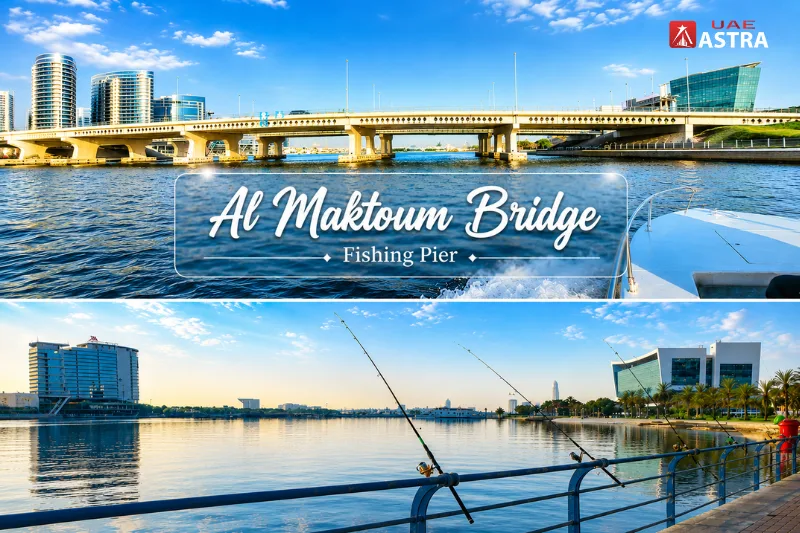

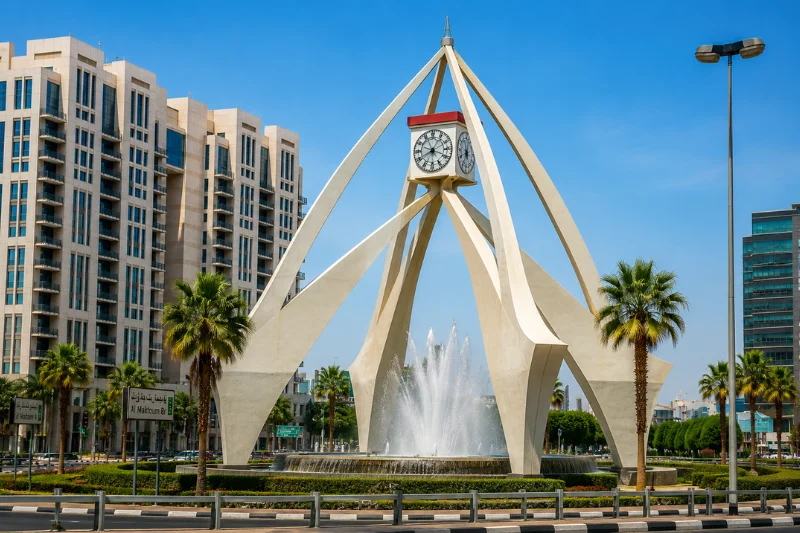
Clock Tower Roundabout, officially known as the Deira Clock Tower Roundabout, is a historic landmark in Deira, Dubai. It was built in 1968 and is one of the first modern monuments to be built in Dubai, and has come to represent the city’s fast growth. For over 50 years, the building’s unique shape of concrete arches and its proximity to Al Maktoum Bridge have made it one of the most easily recognized landmarks in Dubai. The monument is also part of the UAE Ministry of Culture’s Modern Heritage initiative.
The Dubai Clock Tower Roundabout was not just about the arrival of passengers in the city, but also marked the entry of residents, long before the city gained renown for the Burj Khalifa and Palm Jumeirah. It was originally designed as a major roundabout for the movement of traffic, but it is now an architectural landmark of Dubai, dating back to the end of the 1960s, as part of its modernization, infrastructure development, and urban planning.
The Clock Tower is still a significant part of Dubai’s heritage today. The landmark was redeveloped by Dubai Municipality in 2023, and it still preserves its historical character with much improved landscaping, lighting, and fountain systems, and remains a popular landmark for visitors and locals.
Quick Facts About Clock Tower Roundabout
| Feature | Details |
|---|---|
| Official Name | Deira Clock Tower Roundabout |
| Common Name | Clock Tower Roundabout, Dubai Clock Tower |
| Location | Deira, Dubai, UAE |
| Year Built | 1968 |
| Architectural Style | Regional Modernism |
| Designers | Otto Bulard (concept), Ziki Homsi (design development) |
| Original Purpose | Landmark and major traffic roundabout |
| Nearby Landmark | Al Maktoum Bridge |
| Heritage Status | UAE Ministry of Culture Modern Heritage Initiative |
| Major Redevelopment | 2023 by Dubai Municipality |
Why Clock Tower Roundabout Became a Symbol of Dubai

There are now dozens of internationally known attractions in Dubai. In the 1960s and 1970s, however, the city was quite devoid of monumental buildings. The Clock Tower Roundabout was one of the first buildings to represent modern Dubai.
It was near Al Maktoum Bridge and was a visual entrance to Al Deira, which was the main commercial area at the time. This junction used to link some of Dubai’s vital transport routes before the construction of Sheikh Zayed Road and numerous modern roads.
According tothe UAE Ministry of Culture, the tower had become a part of people’s recollection of coming to Dubai, and was one of the city’s first urban icons.
A Landmark That Represented Progress
The Clock Tower was not a mere decorative monument, but a symbol of Dubai’s aspirations for modernization.
- Expansion of Dubai’s road infrastructure
- Growth of international trade
- Modern urban planning
- Improved connectivity between Deira and Bur Dubai
- Emergence of Dubai as a regional business hub.
The simple form of the architecture enabled it to stand out from the surrounding environment while maintaining the traffic flow around the roundabout. This method was in keeping with modernist design theory, known as “form follows function“.
The History of Clock Tower Roundabout

The genesis of the Clock Tower is in the late 1960s, when Dubai was making a significant investment in its infrastructure through the reign of Sheikh Rashid bin Saeed Al Maktoum.
The UAE Ministry of Culture says the concept for the monument came about when his clock, presented to Sheikh Rashid by his son-in-law, was given to the ruler. Architects suggested this new landmark be based around the clock, rather than setting it into a traditional building.
The resulting architecture was one of the first monumental public buildings in Dubai.
Timeline
| Year | Event |
|---|---|
| 1968 | Original Clock Tower completed |
| 1970 | Tower rebuilt using improved concrete technology after deterioration |
| 2010 | Original clock upgraded with GPS-controlled Omega system |
| May 2023 | Dubai Municipality began redevelopment project |
| August 2023 | AED 10 million redevelopment completed |
The monument’s historic identity was preserved, while modern landscape architecture, advanced lighting systems, and the redesigned fountain were introduced.
Architecture and Design Philosophy
The timeless architectural design of the Clock Tower is one of the many reasons that it remains relevant for decades.
The original concept was conceived by Otto Bulard; architect Ziki Homsi expanded on the concept and was responsible for the construction of the design under Architecture Design Construction (ADC).
This monument is a departure from the traditional tower that is loaded with decorative elements, and instead favors minimalism.
It is defined by its characteristics:
- Four large concrete arches that are reinforced.
- Ventilated central opening for good visibility of traffic
- Elevated four-sided clock
- Symmetrical geometry
- Open structural composition
The use of these architectural features was deliberate.
The arches serve not only to block out views around the roundabout, but they also frame the clock above, keeping motorists’ line of sight uninterrupted.
This skilful mix of engineering and aesthetics is still one of the structure’s most admired design triumphs.
Why the Structure Was Rebuilt Only Two Years Later
An important, but little-known, aspect of the monument’s history concerns the early reconstruction.
The original Concrete for the Clock Tower was “hand” mixed and subsequently decayed from corrosion of the materials.
In 1970, engineers rebuilt the structure to incorporate new technologies in concrete construction and maintain the original structure.
In making this decision, Dubai was demonstrating its concern for preserving one of its earliest public monuments, instead of building a new one.
Location of Clock Tower Roundabout in Dubai
The Clock Tower Roundabout has remained relevant over the years because of its location. The monument is located in Dubai’s oldest commercial area, Deira, at a junction of Al Maktoum Road (D89) and Umm Hurair Road (D79) just before Al Maktoum Bridge. This was its principal access point between Deira and Bur Dubai before Dubai was developed along Sheikh Zayed Road.
The Clock Tower remains a familiar landmark for those living in, working in, and using the city center, due to its central position.
Nearby Areas
Several popular districts and business areas are located near the monument:
- Al Rigga
- Port Saeed
- Dubai Creek
- Deira City Centre
- Al Garhoud
- Al Muraqqabat
- Bur Dubai (via Al Maktoum Bridge)
The roundabout is one of the busiest transportation nodes in old Dubai, as it is located in these places.
How to Reach Clock Tower Roundabout

The landmark can be easily reached from Dubai’s public transport and private vehicles.
By Dubai Metro
The nearest metro stations are:
| Metro Station | Approximate Walking Time |
|---|---|
| Al Rigga Metro Station | 8–10 minutes |
| City Centre Deira Metro Station | 10–12 minutes |
| GGICO Metro Station | Around 20 minutes |
The monument can be reached from Dubai International Airport, Downtown Dubai and Dubai Marina by the Dubai Metro Red Line without changing to another line.
By Car
The landmark can be accessed by visitors from various parts of Dubai by means of:
- Sheikh Rashid Road
- Al Maktoum Road
- Umm Hurair Road
- Airport Road (D89)
- The Al Garhoud Bridge is the first to be connected.
- Al Maktoum Bridge
Due to the monument being located within an active traffic roundabout, the public does not have access to the monument area within the centre of the roundabout landscape. It is typically viewed and photographed from nearby sidewalks, nearby hotels, or surrounding streets by visitors.
The 2023 Redevelopment Project
The Clock Tower Roundabout served Dubai for over 50 years, and in 2023 it was restored for the first time in its history.
Dubai Municipality led the project, which sought to maintain the landmark’s historic character while updating its contemporary environment and public image. Construction started in May 2023 and was finished early in 2023 at an estimated AED 10 million.
This redevelopment has preserved the original concrete tower and, through the addition of new and improved elements, enhanced the surrounding environment—rather than replacing the tower with a new structure, as many restoration projects do, which would significantly change the monument.
Major Improvements
The redevelopment brought in some well-thought-out improvements:
- New hard landscaping around the roundabout
- Redesigned water fountain
- Three-dimensional architectural lighting
- RGB programmable fountain lighting
- Smart fountain controls that adjust water height according to wind conditions
- Fresh exterior finishes for the tower
- Washingtonia palm trees
- Decorative flowering plants and sustainable ground cover
- Event lighting capable of displaying national colors and special visual projections
The aim was to enhance the image of this landmark, preserve its architectural heritage and integrate it with the Dubai 2040 Urban Master Plan, Dubai Municipality said.
The Engineering Behind the New Fountain
The most obvious improvement during redevelopment was the entirely reworked fountain.
The engineer’s plan is not to put a traditional round fountain under the tower but to design a plan that reflects the structure of the monument.
The four main arms of the fountain face in the same direction as the supporting arches of the tower, making the fountain and the structure appear to be visually linked.
Inside, several nozzles shoot water up to 5 metres, and built-in RGB lighting allows it to change colour when used in the evening. A smart sensor automatically regulates water pressure according to wind conditions to eliminate overspray and maximize efficiency.
Why the Clock Tower Still Matters Today
Today, the City of Dubai has become a global destination for iconic attractions like the Burj Khalifa, Museum of the Future, and Palm Jumeirah, but Dubai’s Clock Tower remains a symbol of the city’s heritage.
It is not important in terms of height or scale.
Rather, it was the beginning of the transformation of Dubai from a trading port for the region into a modern global city.
The monument is frequently cited in the writings of urban historians as one of the first buildings in the city to be constructed as a place of arrival. The tower, as viewed by the residents for generations after crossing the Dubai Creek, was a sign of getting into the commercial heart of Dubai. The Ministry of Culture is also a witness to the city’s collective memory.
Clock Tower Roundabout and Dubai’s Urban Development
The monument will also show the approach to urban development in Dubai.
The city has taken the pragmatic approach of retaining a number of landmarks of historic significance and incorporating them into the current infrastructure as the city has grown.
The restoration of the Clock Tower is reflective of this principle, as it reconstructs the tower while retaining the monument’s form through the use of contemporary planting, lighting, and landscape architecture, while simultaneously remaining environmentally sustainable.
Nearby Attractions Around Clock Tower Roundabout

Numerous Dubai’s iconic commercial, cultural, and leisure spots surround the Clock Tower Roundabout. The monument is located in the heart of Deira and can be easily enjoyed in combination with a half-day or full-day tour of Old Dubai.
| Attraction | Approximate Distance | Why Visit |
|---|---|---|
| Deira City Centre | About 1 km | Shopping, dining, entertainment |
| Dubai Creek | About 2 km | Historic waterfront and abra rides |
| Gold Souk | About 4 km | One of the world’s largest traditional gold markets |
| Spice Souk | About 4 km | Traditional spice, perfume, and herb market |
| Al Seef | Around 5 km | Heritage-inspired waterfront district |
| Dubai Frame | Around 6 km | Panoramic views of old and new Dubai |
These attractions represent how the Clock Tower marks the transition between the past and the present in Dubai.
Best Time to Visit Clock Tower Roundabout
The monument is open throughout the day, but the visit experience is very different at different times of the day.
Morning
Its architectural features are best appreciated in the early morning, when the traffic is light, the day is not so bright, and the light is not as intense.
Sunset
The monument looks even better in the light of day as darkness approaches. The surrounding skyline, greenery, and fountain provide a unique background, capturing the essence of both the old and the new Dubai.
Evening
The Clock Tower is now very aesthetically pleasing at night thanks to the redevelopment and the fact that it is now programmable architectural lighting as well as illuminated fountains. RGB lighting and projection are also utilised during some national events and civic activities.
Can You Walk Inside the Roundabout?
One of the top searched questions is this one.
No. The landscaped centre of the Clock Tower Roundabout is not open for public access because it is surrounded by active traffic. The monument should be viewed from the adjacent pavements, pedestrian areas, hotels, or adjacent roads.
There are no public pathways into the centre of the roundabout for safety reasons.
Interesting Facts About Clock Tower Roundabout
Although it’s a popular topic, there are a few interesting facts about the landmark that aren’t always mentioned.
- It is one of the first purpose-built civic monuments in Dubai.
- The idea was conceived after a gift clock was presented to Sheikh Rashid bin Saeed Al Maktoum.
- The building was reconstructed in 1970 with advances in concrete technology made in the building industry, when the original hand-mixed concrete began to show signs of deterioration.
- It is built on four wide arches which give rise to a four-faced clock so that it can be seen from all sides.
- The hollow has been purposefully created to maintain views for drivers and highlight the monument above.
- The Clock Tower has stayed in place for over 50 years and is one of Dubai’s oldest urban landmarks.
- The redevelopment in 2023 retained the original architectural shape in place, rather than building something new.
Common Misconceptions
“It was Dubai’s first landmark.”
Not exactly.
The Clock Tower is undoubtedly one of Dubai’s first modern landmarks, but by no means the city’s first historic structure. Al Fahidi Historical Neighbourhood, traditional forts, and parts of Dubai Creek are older than it is, dating back many decades. The special thing about the Clock Tower is that it was one of the first modern city monuments to represent the city of Dubai’s rapid development.
“The current tower is entirely original.”
This is also not true.
The structure has been built in the same design since 1968, but in 1970 it was rebuilt with a more modern construction technique because of damage to the concrete by corrosion. The recent redevelopment did not deal with demolition of the monument, but rather restoration and landscape enhancement.
Visitor Tips
These practical tips can enhance your Dubai itinerary if you are planning to visit the Dubai Clock Tower.
- Visit Old Dubai with Dubai Creek, Gold Souk and Spice Souk.
- After dark, see the lighting of the architecture and the redesigned fountain.
- Avoid any traffic by using the Dubai Metro Red Line and walking from Al Rigga or City Centre Deira Stations.
- Keep in mind the best vantage point for the monument is from the surrounding public spaces, the roundabout being off-limits.
- Photographing the tower: keep to designated pedestrian pathways near the junction and use caution.
Why Clock Tower Roundabout Remains Relevant
As time passes, many cities end up losing their original landmarks, as their skylines change. In Dubai, the approach has been to preserve the important monuments and make them a part of modern city development.
The Clock Tower still has three very important functions:
- A heritage landmark which is a testimony to Dubai’s modernisation in the late 1960s.
- A Regional Modernist icon of architecture and engineering function.
- A landmark which is always familiar to locals and tourists alike.
It has been preserved by Dubai Municipality and recognized by the UAE Ministry of Culture, which indicates that heritage holds significance in Dubai’s long-term urban plans.
Conclusion
The Clock Tower Roundabout is much more than a traffic roundabout. It is a significant milestone in Dubai’s evolution from a small trading port to one of the world’s most important cities. The monument was completed in 1968, making it one of the first modern civic structures in Dubai, and it remains a testament to the city’s dedication to thoughtful urban planning, architectural innovation, and the preservation of its heritage.
It is well known for its unique 4-arch design, its location in Deira, and its long history in the daily life of the people of this city. Dubai Municipality’s careful restoration work in 2023 is a testament to the city’s dedication to preserving its historic landmarks while incorporating contemporary features and sustainable solutions.
The Clock Tower is always worth a visit, whether you’re an architecture enthusiast, an enthusiast of Old Dubai, or a photographer looking for a great photo opportunity. The center of the roundabout is not accessible to visitors, but the monument is easily viewed from the nearby public areas and is a great place from which to explore Dubai Creek, Dubai’s traditional souqs, and other historic neighborhoods.
Over 50 years since it first graced Dubai’s skyline, the Clock Tower remains a landmark that connects the old with the new, a testament to the fact that many of Dubai’s most significant landmarks are not so much for their height as for the history they embody.
You may Also Like:
Dubai Frame Offers One of the Most Unique Views Across the City
Frequently Asked Questions
Where is Clock Tower Roundabout located?
Clock Tower Roundabout is located in Deira, Dubai, at the junction of Al Maktoum Road (D89) and Umm Hurair Road (D79), close to Al Maktoum Bridge and Dubai Creek. It is considered one of the most prominent landmarks of Old Dubai for its central location.
Why is Clock Tower Roundabout famous?
The monument is well-known due to its status as one of Dubai’s first modern monuments, completed in 1968. It was the main entrance to the city and was a symbol of Dubai’s modernization and economic growth for many years.
Who designed the Clock Tower Roundabout?
The original idea was conceived by Otto Bulard and then developed by architect Ziki Homsi and built under his supervision and by Architecture Design Construction (ADC) according to the UAE Ministry of Culture.
When was the Clock Tower Roundabout built?
It was completed in 1968. The building was reconstructed in 1970, with the implementation of new concrete technology, as a result of deterioration in the hand-mixed concrete.
Was the Clock Tower recently renovated?
Yes. The substantial restoration and landscape redevelopment project was finished by Dubai Municipality in 2023. The project maintained and enhanced the historic monument, while incorporating a redesigned fountain, smart lighting, new landscaping and enhanced public presentation.
Can visitors walk inside the Clock Tower Roundabout?
No. This center is not pedestrian-friendly as it is surrounded by active traffic and a landscaped area. The monument can be viewed from the surrounding sidewalks, hotels, or public areas.
What is the nearest Dubai Metro station?
It is close to the following metro stations:
- Al Rigga Metro Station
- City Centre Deira Metro Station
Both stations are on the Dubai Metro Red Line, and can be walked to the monument.
Is Clock Tower Roundabout a heritage landmark?
Yes. The UAE Ministry of Culture has made the Deira Clock Tower a part of its country’s Modern Heritage programme owing to its architectural, historical and cultural values.
What attractions are close to Clock Tower Roundabout?
There are a number of popular attractions nearby, such as:
- Dubai Creek
- Deira City Centre
- Gold Souk
- Spice Souk
- Al Seef
- Dubai Frame
These vacation spots can be easily incorporated into a single sightseeing package.
What is the best time to visit Clock Tower Roundabout?
The ideal time of the day to visit is the evening when the architectural illuminations and the new fountain of the monument are lit up. Early mornings are also ideal for photography and less traffic.